

Junior Bible Quiz (JBQ) preparation often happens between school, homework, jobs, church commitments, and family activities. A practical approach should give children consistent opportunities to learn while allowing families to adjust when a busy day gets in the way. The key is to distinguish two stages: learning questions for the first time and reviewing questions a child already knows.
Stage 1: Learn a Manageable Number of New Questions
When a child is beginning a new set, start with a specific, achievable goal—for example, five new questions in approximately 15 minutes. Read each question, teach the answer, and invite the child to repeat it and then recall it without help. A family might skip a day during a heavy homework week and resume the following day. Consistency over time matters more than forcing every session to follow an inflexible schedule.
Adjust the workload to the child. Short-answer questions may be learned more quickly; longer answers and quotation questions often need smaller chunks and additional repetition. Set targets according to the actual assigned question set, not an assumption that every question requires equal effort.
Stage 2: Change the Goal from Learning to Recall
Once the assigned material is learned, the emphasis shifts to accurate, confident retrieval. For some families, this shift can happen three or more weeks before a meet; for others, new learning may continue closer to competition day. The schedule should follow each child's readiness rather than a fixed cutoff.
A quick review of a smaller 10-point set might take around 15 minutes, while mixed 20- and 30-point material—especially in a larger question set—can take 30–45 minutes or longer. Those times are illustrations, not requirements. Families can break longer reviews into shorter sessions.
Divide Practice Between Adults When Possible
One useful way to reduce the burden on working families is to divide a long revision session by question type. One adult can cover non-quotation questions and another can cover quotation questions; families can reverse the arrangement according to their strengths and availability. This creates a natural break for children and avoids placing a continuous 30–45-minute reading session on one parent.
Single-parent households or families with only one available adult can use the same principle by splitting the session into two blocks or using the app's read-aloud feature. The aim is to share or streamline the work, not to prescribe a particular family arrangement.

Use JBQ Companion to Make Limited Practice Time Count
The JBQ Companion Learn module can help families organize questions by learning progress. Use the app's learning statuses—Not Started, Learning, Almost Mastered, and Mastered—to decide what needs attention next.
If only 10 minutes are available, focus first on Learning and Almost Mastered questions, rather than spending the entire session repeating already-Mastered material. Mastered questions should still receive occasional checks to make sure recall remains strong.
The app's question read-aloud functionality also helps adults who want to listen and assess without reading every item themselves. A parent can play a question, listen to the child's answer, record progress, and advance to the next question. The app supports the practice routine; parents and coaches still judge whether an answer was understood and recalled accurately.

Train Quick Recognition—and Teach When to Wait
Experienced quizzers benefit from identifying a question based on its announced point value and opening words. During fast drills, an adult might announce "20-point question" and read only the beginning of the question. The child should recognize the intended question and give the correct answer when there is enough information.
Similar openings are a valuable training opportunity. Two questions may start with the same words but ask for different information. Practice recognizing when the point value or an additional word is needed, rather than encouraging children to guess immediately.
For an additional challenge, adults can stop partway through a word during a home drill, imitating the interruption a quizzer may hear after buzzing. This is a practice technique, not a claim about an official quizmaster's required stopping point. Use the exact text and point values from the relevant JBQ question bank; do not create or approximate official question wording.
Make Saturday a Full Mixed Review
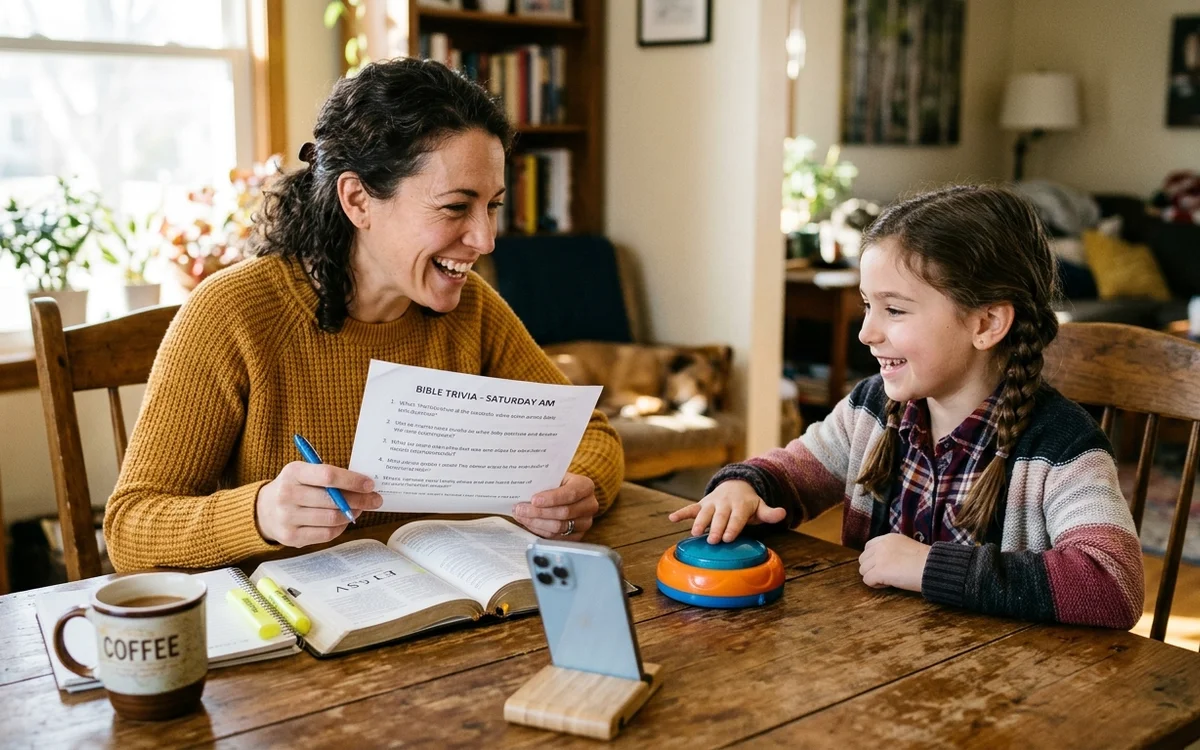
A helpful weekly rhythm is brief, targeted revision during weekdays followed by a more thorough Saturday session before Sunday church practice. During shorter sessions, parents may split quotation and non-quotation questions for efficiency. On Saturday, one adult can run a mixed review in the official alphabetical order, covering both question types together.
This switch is intentional. A child who has practiced each question type separately must also learn to distinguish similar openings when quotation and non-quotation items appear together. Keep the Saturday session realistic for the child's stamina; breaks are appropriate.
Example Weekly Review Schedule
This example is for the revision stage, after the child has learned the assigned questions. Adapt the question types and duration to the family, the current meet, and the child's progress.
Keep the Plan Flexible and Encouraging
A good routine serves the child rather than becoming another source of pressure. Review progress regularly, celebrate improvement, and adjust targets when school, health, or family commitments change. Families should prioritize sound recall and confidence over completing a rigid number of minutes.
As a meet approaches, keep the focus on the questions the child is expected to know, practice recognizing similar openings, and provide periodic full-set reviews. Combining a manageable home plan with the JBQ Companion Learn module can help families use their available time more effectively.
About JBQ Companion
JBQ Companion is a mobile application designed to support Junior Bible Quiz preparation.
Features such as question review, read-aloud practice, learning-progress tracking, and buzzer exercises can help parents, coaches, and quizzers organize their practice sessions.
Learn more at www.jbqcompanion.com.
This article provides practical study planning guidance based on Junior Bible Quiz coaching and family experience. Question assignments, study techniques, and practice schedules are not official competition rules. Individual churches and families should follow the applicable guidelines of their district or organizing body.