
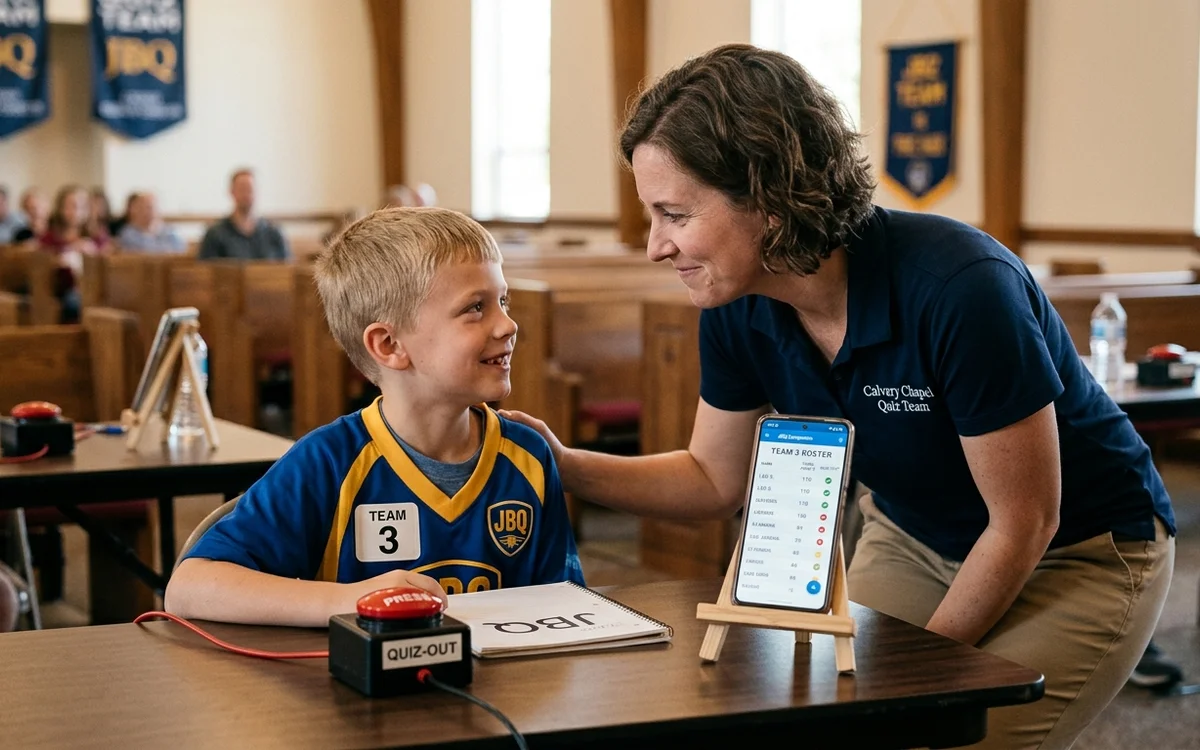
During a Junior Bible Quiz (JBQ) match, a coach has several responsibilities beyond preparing children to answer questions.
Coaches must observe their team's performance, recognize when quizzers are struggling, decide when to use a timeout, manage available substitutes, and follow strict communication rules.
A coach may also unintentionally influence a match by speaking, making a sound, or signaling to a quizzer at the wrong time.
These actions can lead to penalties or affect how a question is handled.
Understanding these situations helps coaches make better decisions and maintain a fair competition.
This guide explains the official rules for team fouls, timeouts, and substitutions, along with practical coaching strategies based on real JBQ match situations.
Official rule source: The official rules referenced throughout this article are from the Assemblies of God Junior Bible Quiz Official Quiz Guidelines, updated July 2024.
1. What Is a Team Foul in Junior Bible Quiz?
A team foul occurs when someone other than an active quizzer commits certain violations during a match.
This commonly involves a coach or inactive quizzer.
Under the official guidelines, each team foul results in a five-point deduction from the team score.
Unlike individual fouls, which are recorded against active quizzers (see our guide on JBQ quiz-outs, strike-outs, and individual fouls), team fouls are recorded against the team.
Examples of team fouls include:
- A coach or inactive quizzer communicating improperly.
- A coach or inactive quizzer providing help to an active teammate.
- A coach continuing to speak after time is called during a Coach's Appeal.
- Using an appeal solely to obtain additional coaching time.
- Improperly using a Point of Order to challenge the correctness of a response.
- Unsportsmanlike conduct by a coach or inactive quizzer, as determined by the officials.
An important distinction is that team fouls do not count toward an active quizzer's three-individual-foul limit.
A team foul affects the team score, not an individual quizzer's foul-out count.
2. Team Fouls Versus Individual Fouls
Coaches and scorekeepers should understand the difference between these two penalties (reviewed in detail in our beginner's guide to JBQ scoring rules):
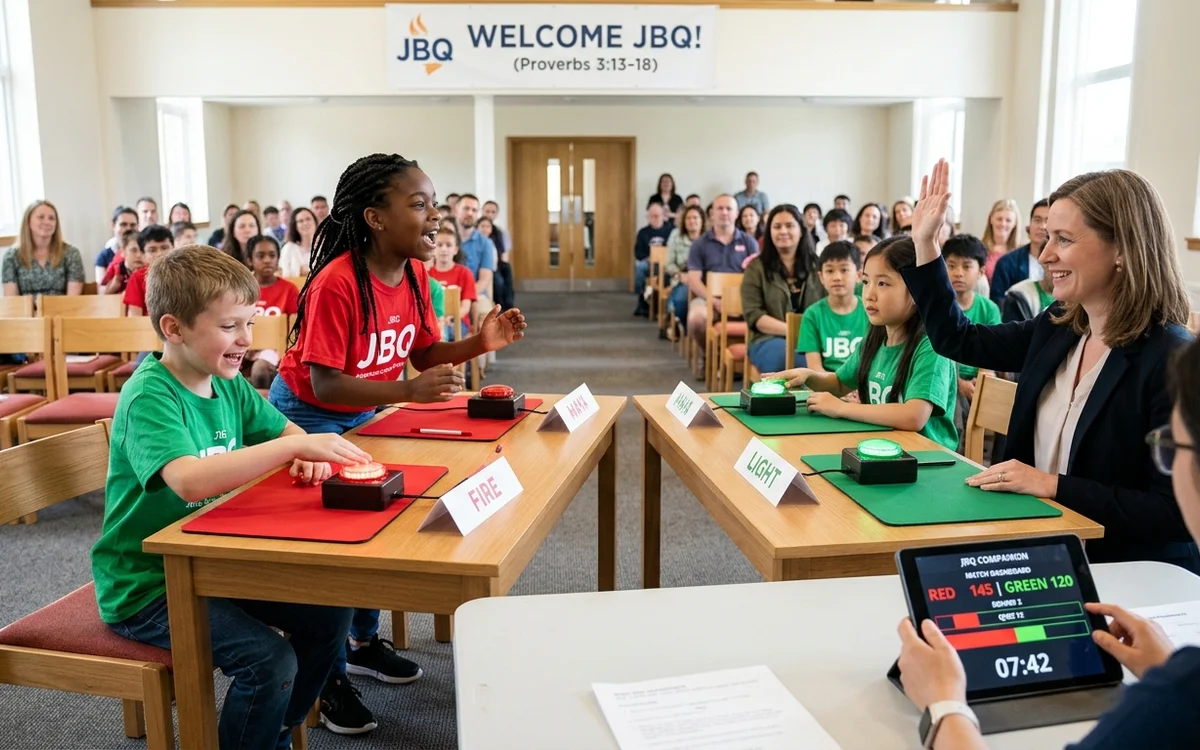
For example, suppose Red Two buzzes during a question. Red Three, another active quizzer, whispers part of the answer.
That is an individual-foul situation involving Red Three (see interruptions, rereads, and wrong quizzer responses explained).
But if Red Team's coach provides the answer, the foul is assessed against the team.
The question may also need to be voided or replaced under the official rules.
That is why the scorekeeper must distinguish between the foul deduction and the procedure used to resolve the question.
3. What Happens When a Coach Helps a Quizzer?
Sometimes a coach's reaction can unintentionally influence the quizzer.
Consider this situation:
- Red Two buzzes and begins answering a 20-point question.
- The coach realizes that Red Two may be making a mistake.
- The coach quietly says a word, mouths an answer, or makes a deliberate sound intended to help Red Two correct the response.
Under the official guidelines, improperly helping an active quizzer is a team foul. The team loses five points.
If the assistance occurs after the quizzer has buzzed, the question must also be handled according to the rules for help and voided questions.
In the ordinary two-team situation, when Red Team provides help to its own responding quizzer, the question is voided and a substitute question of the same value is given to Green Team.
Does Red Two Also Receive an Incorrect-Answer Penalty?
Not automatically.
If the question is voided because of improper help, the original response is not simply scored as an ordinary incorrect answer.
The five-point team foul applies to Red Team, while the appropriate replacement question goes to Green Team.
This differs from a normal incorrect answer, which would result in a deduction of half the question's value.
Coaches should never attempt to correct a quizzer's response through words, sounds, gestures, or signals during an active question.
4. What If a Parent or Audience Member Helps?
Not every person in the room belongs to one of the competing teams.
Parents and spectators may be watching from the audience.
Occasionally, an audience member may unintentionally say part of an answer or react in a way that helps a quizzer.
For example:
- Red Two buzzes on a question and begins responding.
- A parent associated with Red Team calls out a number or a word that could help Red Two complete the answer.
In this situation, the official guidelines require the question to be handled under the rules for audience help.
If the audience assistance is connected to the responding team, the original question is voided and a substitute question is given to the opposing team.
Is There an Automatic Team Foul?
No.
Audience assistance does not automatically create a five-point team foul merely because the spectator supports a particular church.
The question may be voided, but a foul is assessed only when a specific foul guideline applies.
This distinction is especially important for new quizmasters and scorekeepers.
The official ruling depends on the precise circumstances, including the source of the assistance and which team was affected.
5. What If There Is a Distraction Before Anyone Buzzes?
Junior Bible Quiz competitions often take place in churches with parents, younger children, and other spectators.
Occasionally, a baby may cry, a phone may make a loud noise, or someone may create a disturbance during a question.
Not every minor noise requires officials to stop the match.
However, if there is obvious help or hindrance before a quizzer buzzes, the official guidelines provide a corrective procedure.
The affected question is voided and a substitute question of equal value is read to both teams.
Example: A Loud Distraction
The quizmaster begins reading a question.
Before anyone buzzes, a sudden loud disturbance prevents the quizzers from hearing the question properly.
The quizmaster and judges determine that the distraction constitutes a hindrance under the guidelines.
The question is voided and replaced for both teams.
Practical Advice for Quizmasters
When ongoing audience noise becomes a problem, it is usually better to address the issue calmly and respectfully.
The quizmaster can ask a coach or responsible organizer to help resolve the disturbance rather than publicly confronting a parent (see our guide on handling parent conflicts in Junior Bible Quiz).
The objective is to restore a quiet, fair environment—not embarrass anyone.
Ordinary background noise and an actual rule-defined hindrance are not necessarily the same thing.
6. Understanding Official JBQ Timeout Rules
Each team receives three team timeouts during a regulation match.
A normal team timeout lasts 30 seconds.
A timeout may be requested by the team's head coach or designated captain.
The request must occur after a question has been concluded and before the next question is called.
Before granting the timeout, the quizmaster must address any outstanding Points of Order or Coach's Appeals.
What Happens During a Timeout?
During an officially granted timeout, members of both teams may communicate verbally.
Coaches can use this opportunity to:
- Encourage children who are struggling.
- Explain a simple change in buzzing strategy.
- Remind quizzers to listen for identifying words.
- Make an eligible substitution.
- Help the team regain focus.
- Discuss a specific issue without disrupting active questioning.
Because the timeout lasts only 30 seconds, instructions should be brief and practical.
A timeout is most useful when the coach knows exactly what needs to be communicated.
7. When Should a Coach Call a Timeout?
There is no single strategy that works for every match.
A coach should consider the team's current performance, remaining questions, available timeouts, and the seriousness of the problem (explore tactical advice in our 10 practical JBQ coaching strategies).
Situation A: The Team Is Accumulating Negative Points
Suppose an experienced quizzer has answered two questions incorrectly because of premature buzzing.
The coach notices that the child is becoming nervous and is increasingly likely to make another mistake.
A timeout may be useful. The coach could remind the quizzer:
“Slow down. Listen for the word that identifies the question before buzzing.”
The goal is not to criticize the child. It is to help the quizzer regain control.
Situation B: The Team Is Buzzing Too Aggressively
Sometimes a team begins a match by buzzing very quickly without first understanding how the opposing team performs.
This can result in unnecessary negative points.
A coach may use a timeout to encourage more careful listening. For example:
“We don't need to rush every question. Concentrate on accuracy for the next few questions.”
Situation C: The Team Is Losing Confidence
After several difficult questions, younger quizzers may become discouraged.
A short timeout can help the team reset emotionally.
Remind children that each new question is another opportunity. Avoid lengthy criticism or reviewing every previous mistake.
Situation D: The Team Is Performing Well
If the team is answering correctly, communicating through its normal play, and maintaining confidence, calling a timeout may be unnecessary.
Interrupting a successful stretch can disrupt concentration.
A timeout is a strategic option, not a requirement that must be used.
8. Should Coaches Save Their Timeouts?
Some coaches prefer to save timeouts for later in the match.
That can be useful when the team is performing consistently.
However, saving every timeout until the end is not always the best strategy (see our review of common JBQ coaching mistakes).
Suppose a team has several problems during the first ten or twelve questions. Quizzers are repeatedly buzzing too early and losing points.
The coach may need to intervene before the situation becomes worse.
In a difficult match, using all three timeouts relatively early may be justified. In another match, a coach may not need to use any of them.
The correct coaching decision depends on the situation rather than a fixed formula.
A Practical Timeout Decision Table
The important principle is to be deliberate. Use a timeout when it can help the team—not simply because one is available.
9. What Happens to Timeouts During Overtime?
If the teams are tied after the twentieth question, the match proceeds to overtime.
Under the official guidelines, the quizmaster reopens the match and declares a one-minute timeout for both teams.
Remaining team timeouts from regulation may be used during overtime.
Each team also receives one additional timeout for the overtime period.
This is different from the normal three 30-second team timeouts available during regulation.
Coaches should understand these rules before participating in a close match. An overtime situation is not the ideal time to learn the timeout procedure for the first time.
10. Understanding Substitutions in JBQ
A Junior Bible Quiz team may have active quizzers seated at the quiz table and inactive eligible quizzers available as substitutes.
At the beginning of a standard match, two to four active eligible quizzers may be seated at the table.
Under the official rules, teams may replace active quizzers during a timeout.
The head coach must announce that a new active quizzer has entered when the timeout is completed.
Example: Replacing a Quizzer With Two Incorrect Answers
Suppose a beginner assigned primarily to 10-point questions has already answered two questions incorrectly (learn how to manage mixed experience levels in our guide on practicing with beginners and experienced quizzers).
The coach is concerned that the child may strike out after another incorrect response.
If another eligible quizzer is available, the coach may consider a substitution during an appropriate timeout.
This can provide the first quizzer with a break and give another child an opportunity to participate.
However, substitution should not automatically be used as punishment. The coach should explain the decision respectfully and consider what is best for the team and the child's development.
11. Substituting After a Quiz-Out, Strike-Out, or Foul-Out
There is an important exception to ordinary substitution procedures.
If an active quizzer has:
- Quizzed out after six correct answers.
- Struck out after three incorrect responses.
- Fouled out after three individual fouls.
The head coach may immediately replace that quizzer with an inactive eligible quizzer without using a team timeout.
This is an official substitution privilege.
Example: Replacing a Quizzer Who Quizzed Out
Red Two answers a sixth question correctly.
The quizzer receives the quiz-out bonus and must leave the table.
If Red Team has an eligible inactive quizzer available, the head coach may immediately make the replacement.
No team timeout is required for that replacement.
If no substitute is available, the team continues with the remaining eligible quizzers, subject to the official rules.
This distinction can save valuable timeouts during a competitive match.
12. How Should Coaches Plan Substitutions?
Not every church has enough quizzers to make frequent substitutions.
Some teams have only a few active participants and no additional eligible substitutes.
Other churches may have larger rosters, allowing more flexibility.
Coaches should prepare according to the players actually available.
Smaller Teams
When there is no substitute, coaches may need to focus on helping the existing quizzers adjust.
For example, if a quizzer has two incorrect answers, a timeout may be used to reinforce careful listening and controlled buzzing.
The coach cannot simply replace that quizzer if no eligible alternative is available.
Larger Teams
When substitutes are available, coaches can make strategic changes.
For example, a coach may replace a beginner who is struggling with another quizzer who has prepared for the same question level.
In many teams, substitutes may be more common among beginners than among children preparing extensively for 30-point questions.
However, point-level assignments are coaching strategies, not official substitution categories.
The official eligibility rules still determine who may participate.
Important Coaching Principle: A substitution should consider the match situation, quizzer readiness, available eligible players, individual confidence, team strategy, and long-term development. There is no requirement that a coach automatically substitute a child after two incorrect responses.
13. Communication Rules Coaches Must Follow
Junior Bible Quiz has restrictions on communication during an active match.
These restrictions are designed to prevent unfair help or interference.
Under the official guidelines:
- Verbal communication is permitted only in the situations specifically authorized, including timeouts and Coach's Appeals.
- Coaches and inactive quizzers may communicate nonverbally among themselves as long as they do not hinder the match.
- Active quizzers may not communicate with teammates except as specifically permitted.
- Team members may not communicate with audience members during the match.
- Audience members may communicate quietly with one another only during timeouts.
These rules are broader than simply telling coaches not to shout out answers.
A gesture, mouthed word, or deliberate signal can also violate communication rules depending on what occurs.
Why Small Sounds Can Become a Problem
Sometimes a coach hears an incorrect answer beginning and instinctively reacts.
A sigh, deliberate vocal cue, or signal could influence the child.
Not every incidental sound is automatically a foul.
However, coaches should avoid any action that could reasonably communicate information or help a quizzer.
A good coach remains calm and allows the quizzer to complete the response independently.
14. Can Coaches Use JBQ Companion During a Match?
The official guidelines allow electronic devices to record scores and other JBQ-related information, provided the devices do not create a hindrance as determined by the quizmaster.
This makes digital scorekeeping useful for many churches.
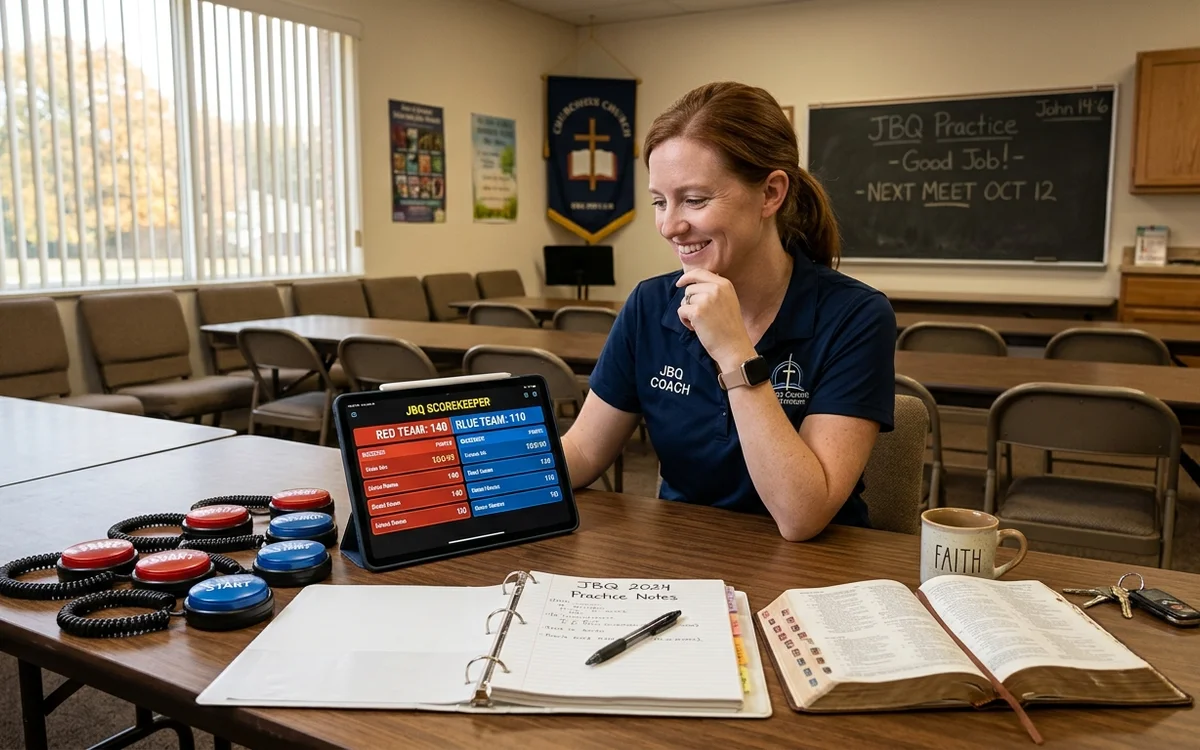
The JBQ Companion Scorekeeper module can help scorekeepers record individual scores, team scores, and match events.
Coaches can also use recorded results to review performance and make better training decisions.
However, using an application does not override the official communication and equipment restrictions.
Digital devices should remain silent and should not be used to provide unauthorized assistance to active quizzers.
For example, the Scorekeeper module may help identify that a quizzer has accumulated two incorrect responses.
The coach can use that information to decide whether to request a timeout.
But the coach should communicate any strategy change only at a time permitted by the official rules.
Technology can support coaching decisions without becoming part of an improper communication process.
15. Common Mistakes Coaches Should Avoid
- Mistake 1: Giving a Hint During a Question: Even a small word or gesture may be interpreted as improper assistance.
- Mistake 2: Calling a Timeout Without a Clear Purpose: A timeout should help solve a specific problem.
- Mistake 3: Using All Three Timeouts Automatically: There is no requirement to use every available timeout.
- Mistake 4: Saving Timeouts While the Team Continues Making Avoidable Mistakes: Sometimes an early intervention is more useful than preserving timeouts for later.
- Mistake 5: Confusing Individual Fouls With Team Fouls: Active quizzer violations and coach or inactive quizzer violations are recorded differently.
- Mistake 6: Assuming an Audience Member's Help Always Causes a Team Foul: Audience interference may require a replacement question, but it does not automatically create a team foul.
- Mistake 7: Forgetting That an Exited Quizzer Can Be Replaced Without a Timeout: An eligible inactive quizzer may immediately replace someone who has quizzed out, struck out, or fouled out.
- Mistake 8: Making a Child Feel Punished for Being Substituted: Coaches should treat substitutions as part of team management and development.
A Quick Reference for Coaches
This table is intended as a quick reference, not a substitute for the complete official guidelines.
Frequently Asked Questions
Must a coach use all three timeouts?
No. A coach may choose not to use every timeout.
Can a coach call a timeout in the middle of a question?
No. A normal team timeout is requested between completed questions and before the next question is called.
Can the team captain request a timeout?
Yes. The designated captain may request one under the official rules.
Does a team foul count toward a quizzer's foul-out?
No. Team fouls and individual foul counts are separate.
Can a coach substitute a quizzer who has two incorrect answers?
Yes, if an eligible substitute is available and the substitution occurs during a permitted timeout.
Is a timeout required to replace someone who has quizzed out?
No. The head coach may make an immediate eligible replacement.
Does help from a spectator automatically result in a five-point team foul?
No. Spectator help can affect the question procedure, but the team foul must be supported by a separate applicable foul rule.
Can a coach communicate through hand gestures during an active question?
Coaches may communicate nonverbally with other coaches and inactive quizzers within the limits of the official rules. They must not signal to active quizzers or hinder the match.
Can digital scorekeeping be used during a match?
Yes, the guidelines permit electronic devices for scorekeeping and related data when they do not create a hindrance.
Final Thoughts
Effective Junior Bible Quiz coaching requires knowing when to act and when to allow the match to continue.
A coach must understand the rules for communication, timeouts, substitutions, and team fouls.
A well-timed timeout may help a nervous quizzer regain confidence. A strategic substitution may give another child an opportunity while protecting the team's performance. Avoiding improper communication can prevent a small reaction from creating a costly penalty.
Most importantly, coaching decisions should remain calm, fair, and focused on helping children develop.
Good JBQ coaching is not about controlling every question. It is about preparing children well, making thoughtful decisions, and supporting them throughout the match.
About JBQ Companion
JBQ Companion is a mobile application designed to support Junior Bible Quiz learning, practice, and match scoring.
Its Learn module helps families organize question preparation, while the Scorekeeper module supports recording match results and monitoring quizzer performance.
Digital scorekeeping can complement coaching decisions by making match information easier to follow.
Learn more at www.jbqcompanion.com.
Official Reference
Assemblies of God — Junior Bible Quiz Official Quiz Guidelines (Updated July 2024)
https://jbq.ag.org/-/media/JBQ/Downloads/HelpfulFiles/2024-Guidelines.pdf
Relevant sections include Team Privileges and Restrictions (page 6), Time-outs (page 8), Fouls and Team Fouls (pages 8–9), and Voiding Questions (page 17).
This article provides practical coaching suggestions alongside explanations of selected official JBQ guidelines. The suggestions are not additional competition rules. Consult the current official rulebook and authorized match officials for unusual situations or disputed rulings.