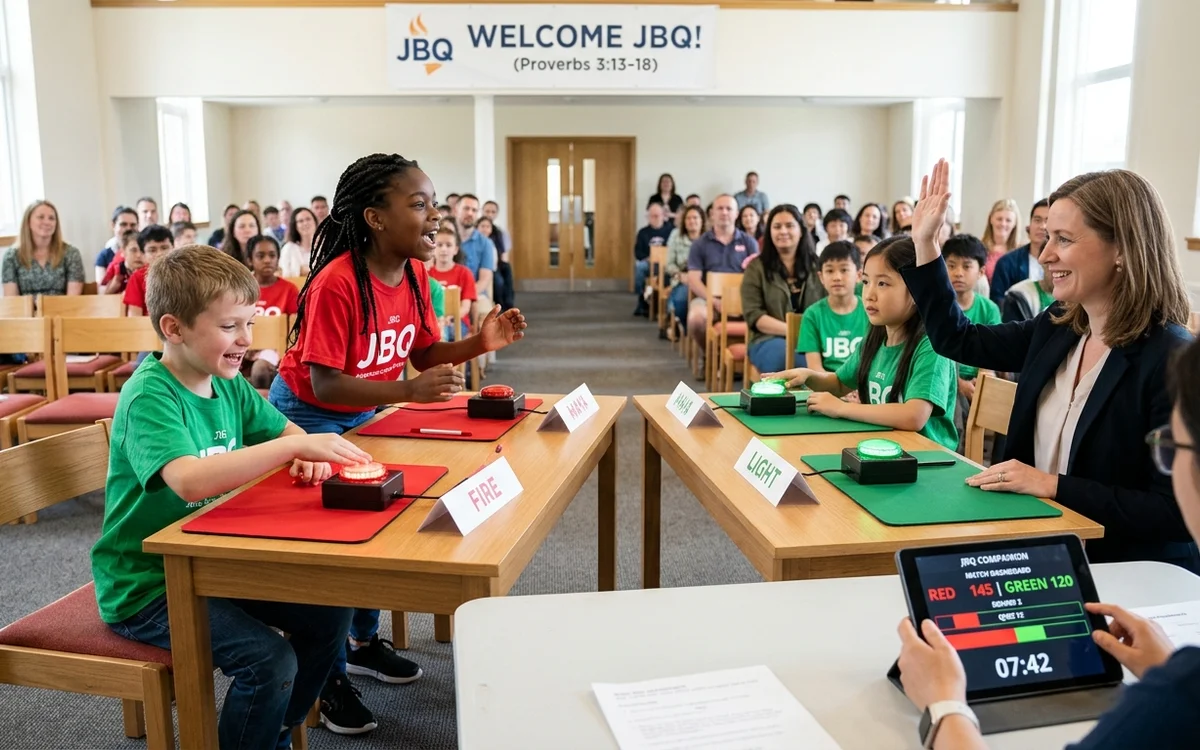
In Junior Bible Quiz (JBQ), a single mistake during a question can change the direction of an entire match.
A quizzer may press the buzzer too early, answer before being identified, or begin responding when another quizzer actually buzzed.
Some of these situations result in an individual foul. Others require the question to be reread or replaced with a substitute question.
Understanding the difference is essential for quizzers, coaches, and match officials.
This guide explains these situations with practical Red Team and Green Team examples, based on the official Junior Bible Quiz Guidelines updated July 2024.
1. A Costly Mistake During an Important Match
Imagine a championship match approaching its final questions.
The score is competitive, and a 30-point question could make a significant difference (see our beginner's guide to JBQ scoring rules for how question points and deductions work).
Green Two recognizes the question and activates the buzzer.
But before the quizmaster identifies Green Two, Green Three begins answering.
Green Three may even know the correct answer.
Unfortunately, knowing the answer does not make the response valid.
Under the official guidelines, when a quizzer who did not buzz and was not identified begins responding, that quizzer receives an individual foul. The original question is voided, and a substitute question is given to the team that did not commit the foul.
In this example:
- Green Two buzzed.
- Green Three responded without being identified.
- Green Three receives an individual foul.
- The original question is voided.
- Red Team receives a substitute question of the same point value.
- Green Two does not get to continue answering the original question.
A situation like this can be especially disappointing near the end of an important match. It is also a reminder that every quizzer must understand the basic procedure for responding.
Core procedural rule: The first responsibility after a buzzer sounds is to identify who actually buzzed. The correct answer comes afterward.
2. What Is an Interruption in Junior Bible Quiz?
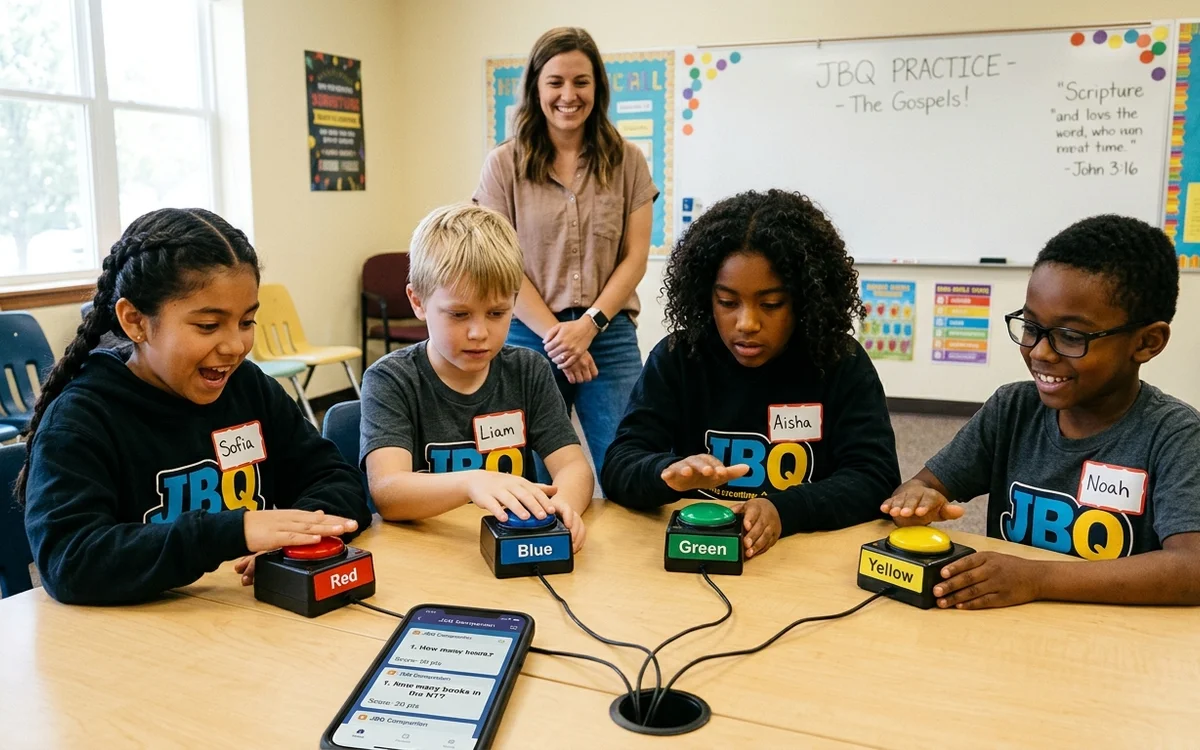
An interruption occurs when an active quizzer buzzes after the question's opening announcement but before the quizmaster has formed the last word of the question.
When this happens, the quizmaster must stop reading immediately, even if the interruption occurs in the middle of a word.
The quizmaster then announces the interruption and identifies the quizzer.
For example:
- The quizmaster begins reading a 20-point question.
- Green Two recognizes the question and buzzes before the reading is complete.
- The quizmaster stops and identifies Green Two.
- Green Two must complete the interrupted question and provide the correct answer within the permitted response time.
The official guidelines allow 30 seconds after identification for the required response.
Is Interrupting Automatically a Foul?
No.
Interrupting a question is a normal part of JBQ competition.
An interruption becomes costly when the quizzer gives an incorrect response (explore practical drills in our guide on how to improve buzzer speed and accuracy in JBQ).
This is why children should learn to recognize the exact question rather than simply buzzing whenever they hear familiar opening words.
3. What Happens After an Incorrect Interruption?
Suppose Green Two interrupts a 20-point question and gives an incorrect response.
The normal scoring deduction applies.
Green Two loses 10 points.
The interrupted question is then reread to Red Team, unless the question was already being read exclusively to one team.
If Red Team answers correctly, it receives the full 20 points.
This creates a 30-point difference between the teams from those responses.
What Is a Reread?
A reread means the interrupted question is read again, generally for the opposing team.
The quizmaster uses the original question, not a newly selected question.
A reread is not the same as a substitute question.
That distinction becomes important when a foul, official error, or other unusual situation causes the original question to be voided.
4. What Is a Substitute Question?
A substitute question is a new official question used to replace one that has been voided.
The substitute must have the same point value as the voided question.
Depending on the reason the original question was voided, the substitute may be available to both teams or only one team.
For example, if a 30-point question is voided because the wrong quizzer improperly responded, the replacement must also be a 30-point question.
- Reread: The original interrupted question is presented again.
- Substitute: The original question is voided and replaced by a different question of equal value.
Understanding this difference prevents one of the most common procedural mistakes made by inexperienced match officials.
5. When Someone From the Same Team Answers Without Buzzing
Consider this example:
- Green Two buzzes.
- Green Three begins answering without having buzzed or been identified.
- The quizmaster stops Green Three immediately.
Under the official guidelines:
- Green Three receives an individual foul, normally a five-point deduction.
- The original question is voided.
- Red Team receives a substitute question of equal value.
- Green Two does not continue the original question.
This procedure applies even if Green Three gives the correct answer.
The critical mistake is that Green Three responded without being the quizzer who buzzed or the quizzer identified by the official.
Why Coaches Must Teach This Early
Children sometimes become excited when they recognize a question.
They may hear a buzzer and assume they are the one who activated it.
Coaches should train children to pause, check the buzzer indication, and wait for the official identification (read our coaching recommendations in 10 practical JBQ coaching strategies).
A child who knows every answer can still lose an opportunity by responding at the wrong time.
6. What If a Quizzer From the Opposing Team Answers?
Now consider a different situation.
Green Two buzzes, but Red Three begins responding without being identified.
The quizmaster stops Red Three.
According to the official guidelines:
- Red Three receives an individual foul.
- The original question is voided.
- A substitute question of the same point value goes to Green Team, the team that did not commit the foul.
The important principle is consistent.
When an unidentified quizzer who did not buzz begins responding, the offending team loses its opportunity on the original question.
The substitute question is given to the team that did not commit the foul, subject to the special rules that apply when a question was already being read to only one team.
7. What If the Correct Quizzer Answers Before Being Identified?
This situation is different from the previous two examples.
Suppose Green Two buzzes and immediately begins answering before the quizmaster identifies anyone.
Green Two is the correct quizzer—the person who actually buzzed—but responded prematurely.
The official procedure is:
- The quizmaster or a judge stops Green Two.
- Anything said before identification is disregarded.
- Green Two is properly identified.
- The response clock is reset to 30 seconds.
- Green Two is allowed to respond.
- After the response is ruled, Green Two receives an individual foul.
The original question is not automatically voided merely because the correct quizzer began answering before identification.
Green Two's response can still be judged correct or incorrect, and the foul is assessed separately.
This distinction is especially important for new quizmasters.
8. What If the Quizmaster Identifies the Wrong Quizzer?
Sometimes the error comes from the official rather than the child.
Suppose Green Two buzzes.
The quizmaster mistakenly calls Green Three.
There are two important possibilities:
The Mistake Is Corrected Before a Response
If the official recognizes the error immediately, the correct quizzer—Green Two—is identified and the response time is reset.
The Incorrectly Identified Quizzer Begins Answering
If Green Three begins answering after the quizmaster incorrectly identified Green Three, the original question must be voided.
A substitute question goes to Green Team, the team that originally buzzed.
No individual foul is assessed to Green Three merely for responding after the official incorrectly identified that quizzer.
This differs from Green Three answering voluntarily without being identified.
The difference depends on who buzzed, who was identified, and who began responding.
9. What Happens If a Quizzer Buzzes Before the Question Starts?
The opening announcement is not the same as the actual question.
For example, the quizmaster may announce the question number, point value, and whether it is a quotation question.
If a quizzer buzzes during these opening remarks, the official guidelines require an individual foul.
The question is then read again for the same team or teams, and it may still be interrupted during its proper reading.
A pre-question buzz does not follow the same procedure as a normal interruption.
Helping Young Beginners
Some local introductory practice sessions may use reminders or warnings while teaching very young children how the buzzer works (see our practical tips in teaching JBQ to young children who cannot read yet).
That can be useful in a teaching environment.
However, coaches should not assume an informal warning replaces an official foul during a regulated competition.
Before the first meet, explain the difference between the opening announcement and the actual question.
10. What If the Quizmaster Misreads a Question?
Quizmasters are responsible for reading official questions accurately.
A misread can involve adding, omitting, repeating, or changing wording in a way that differs from the official question.
If the quizmaster catches the mistake or a judge calls a misread, the standard procedure is to void the question and use a substitute question for the eligible team or teams.
An important exception applies when the question was already being read only to one team: the official guidelines say that question should be reread rather than voided under the general misread provision.
What Coaches Should Remember
Coaches should avoid interrupting officials informally whenever they disagree with a reading (learn how to handle disagreements respectfully in our guide on handling parent conflicts in Junior Bible Quiz).
The proper corrective procedure, including a point of order or coach's appeal where applicable, should be followed.
The goal is to correct an error without creating additional confusion.
11. What If the Quizmaster Forgets a Reread?
Suppose question five is interrupted and answered incorrectly.
Red Team should receive the reread, but the quizmaster accidentally proceeds to question six.
Under the guidelines, either team can raise a point of order within the specified correction window.
For this example, the point of order may be raised after question six is concluded and before question seven is called.
If the error is not noticed before question seven is called, the omitted reread is no longer given.
This is why officials must keep track of whether an interrupted question has been resolved.
Quizmasters, judges, and scorekeepers should pay attention whenever an interrupted response is ruled incorrect.
12. Teach Every Quizzer to Recognize Their Color and Number
A simple habit can prevent significant mistakes.
Each active quizzer should know the color and number assigned to their position:
- Green One, Green Two, Green Three, or Green Four.
- Red One, Red Two, Red Three, or Red Four.
When the buzzer activates, children should learn to remain quiet until the official identifies the responding quizzer.
If another child is identified, they must not begin answering.
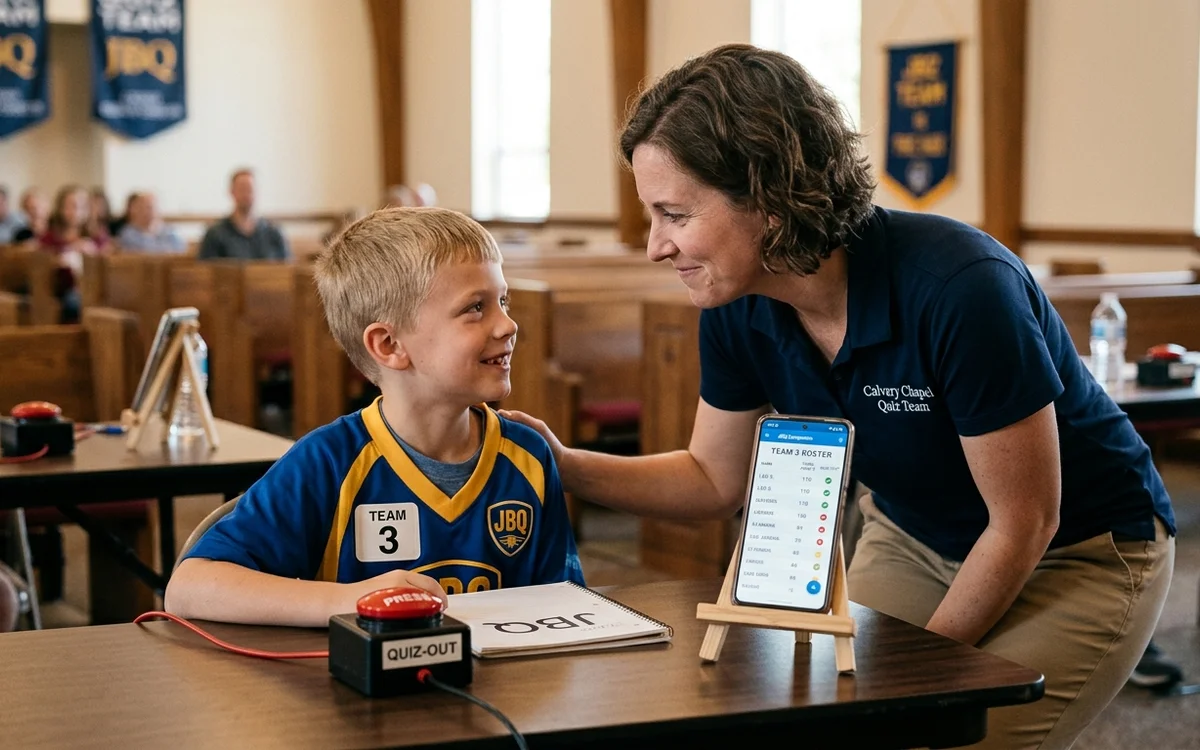
A Simple Practice Drill
During home or church practice (review our realistic JBQ practice plans for busy families):
- Assign each participant a team color and number.
- Read a familiar official JBQ question.
- Have one participant activate the buzzer.
- Call the quizzer's color and number.
- Allow only that identified quizzer to respond.
- Repeat with different positions.
Occasionally simulate an incorrect identification as a teaching exercise, then explain how officials should correct it.
For younger children, focus on developing the habit of listening before answering.
For experienced quizzers, combine identification drills with realistic question interruptions.
This short exercise can help prevent costly mistakes during competitions.
13. A Quick Reference for Coaches and Quizmasters
This table summarizes common situations. Some rulings involve additional exceptions, particularly when a question was already being presented exclusively to one team or when an appeal changes an earlier ruling.
For official competitions, always refer to the full guidelines rather than relying only on a summary.
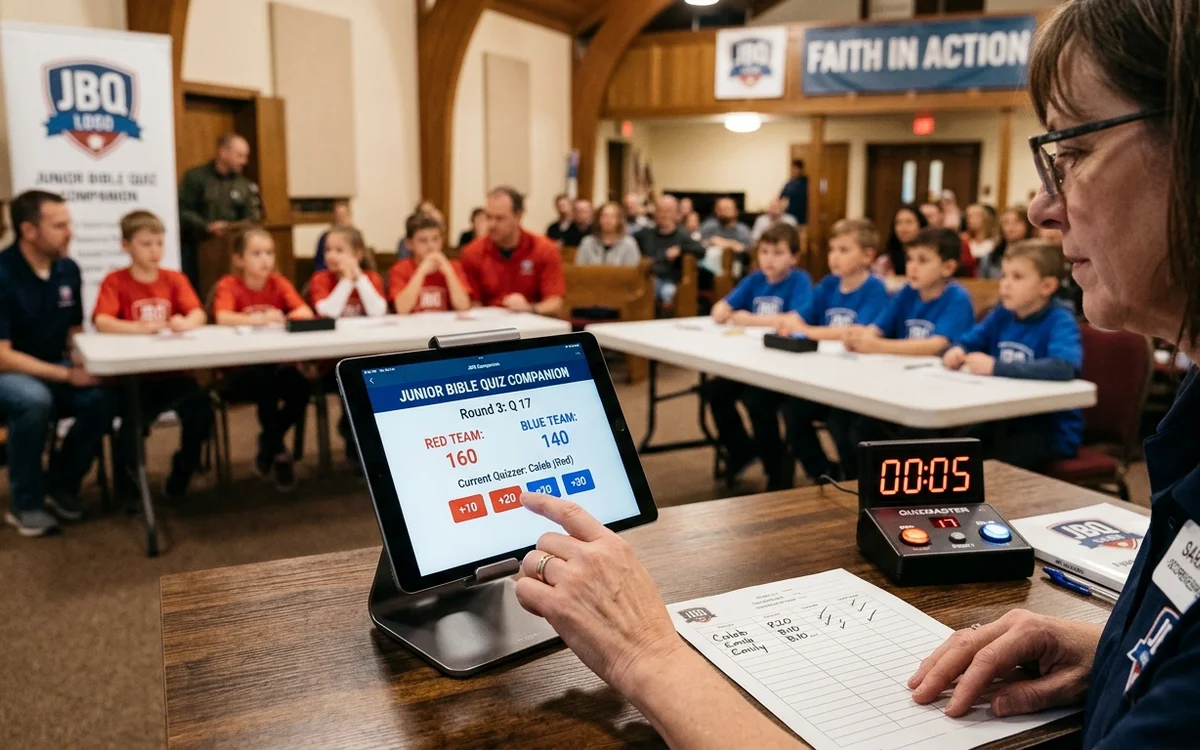
14. How JBQ Companion Fits Into Match Practice
The JBQ Companion app provides tools that can complement question study, buzzer practice, and match scoring.
Parents and coaches can use the Learn module to help quizzers become familiar with official question wording.
The virtual quiz box can support practice using compatible mobile devices.
The Scorekeeper module can help record match results and monitor quizzer performance.
However, no scoring tool should replace the officials' responsibility to identify who buzzed, apply the correct rule, and determine whether the original question should be reread or replaced.
A useful approach is to combine the app with short procedure-focused drills.
For example, coaches can simulate a wrong-quizzer response, explain the ruling, and then resume practice using the correct procedure.
The app supports the learning and scoring process; the official guidelines govern the match.
Common Questions
If the wrong quizzer gives the correct answer, does it count?
No. If that quizzer was neither the person who buzzed nor the person identified by the official, the response does not count. The applicable foul and substitute-question procedure must be followed.
Does every foul require a substitute question?
No. For example, when the correct quizzer answers before identification, the quizzer is stopped, identified, allowed to respond, and then assessed a foul. The question is not automatically substituted.
Does the other team always receive a substitute question?
No. Which team receives the replacement depends on why the question was voided and whether it was already being read to only one team.
Can a quizzer interrupt a reread?
Yes. The normal rules for interrupted questions apply when a reread is properly presented.
Should young children practice color and number identification?
Yes. This is a simple way to develop controlled responses and reduce the risk of answering when another quizzer was identified.
Final Thoughts
One of the hardest lessons in Junior Bible Quiz is that knowing the correct answer is not always enough.
Quizzers must also follow the correct response procedure.
A child can recognize a question perfectly and still lose the opportunity because the wrong person begins answering.
Similarly, an official's identification mistake can change whether a foul applies and which team receives the substitute question.
Coaches should therefore prepare children for both the academic and procedural sides of the competition.
Teach children to listen carefully, recognize their buzzer color and number, wait for identification, and answer only when it is their turn.
Learning these habits during practice can prevent painful mistakes during important matches.
About JBQ Companion
JBQ Companion helps parents, coaches, and quizzers prepare for Junior Bible Quiz through question learning, buzzer practice, and scorekeeping tools.
Its Learn module supports question study, the virtual quiz box supports compatible-device practice, and the Scorekeeper module helps manage quiz match scoring.
Learn more at www.jbqcompanion.com.
Official Reference
Assemblies of God — Junior Bible Quiz Official Quiz Guidelines (Updated July 2024)
https://jbq.ag.org/-/media/JBQ/Downloads/HelpfulFiles/2024-Guidelines.pdf
Relevant sections include Question Reading, Interrupting, and Answering; Quizmaster Duties During the Match; and Voiding Questions.
This article is an educational explanation of selected official guidelines, not a replacement for the rulebook. Consult the complete guidelines and authorized officials when handling exceptional match situations.