
In Junior Bible Quiz (JBQ), a quizzer does not always remain at the table for all 20 questions.
Sometimes a child answers six questions correctly and earns a quiz-out. Another quizzer may leave after three incorrect responses. A third may be required to leave after receiving three individual fouls.
Although these situations may look similar to spectators, the official rules treat them differently.
For parents, coaches, quizmasters, and scorekeepers, understanding these differences is essential.
There is also a more complicated situation: What happens if a quizzer should have left the table, but nobody notices until several questions later?
This guide explains these rules, provides practical examples, and offers suggestions for preventing scoring mistakes.
Official rule source: All official rule explanations are based on the Assemblies of God Junior Bible Quiz Official Quiz Guidelines, updated July 2024.
1. Three Reasons a Quizzer Must Leave the Match
Junior Bible Quiz has three individual exit conditions (for foundational scoring rules, review our beginner's guide to JBQ scoring rules):
These conditions are based on separate counts, not simply on a quizzer's total score.
For example, a quizzer might have a high individual score and still strike out after three incorrect answers.
Another quizzer might have a low point total but quiz out after six correct answers.
Understanding the difference is especially important when keeping score during a fast-paced match.
2. What Exactly Is a Quiz-Out?
A quiz-out occurs when a quizzer correctly answers six questions during the same match.
After the sixth correct response:
- The full point value of that question is awarded.
- The quizzer receives a 10-point quiz-out bonus.
- The quizzer must leave the active quiz table.
Example: Six Correct Answers
Suppose a quizzer answers the following questions correctly:
The quizzer finishes with 130 points in this example, assuming there were no earlier deductions.
However, a quiz-out is not determined by earning 130 points, or any other specific total.
Six correct responses trigger the quiz-out, regardless of the combination of question values.
This is an achievement worth recognizing because it reflects consistent knowledge and performance during the match.
3. What Is a Strike-Out?
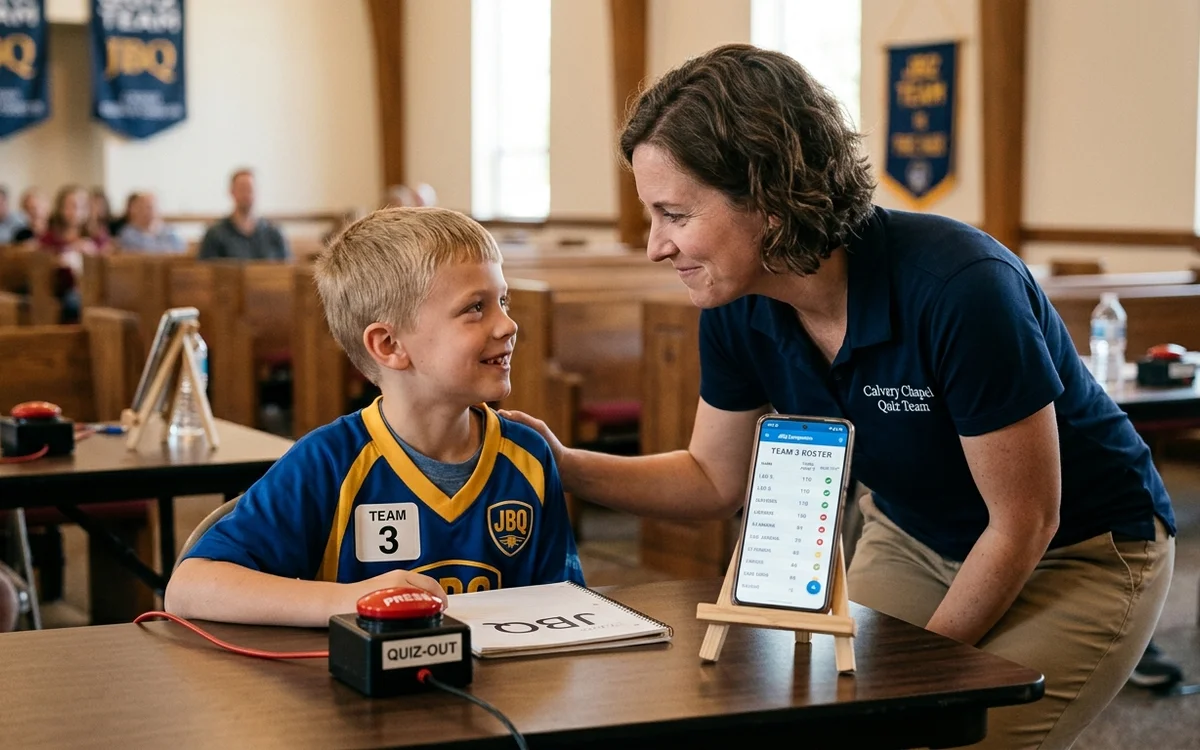
A strike-out happens when a quizzer gives three incorrect responses during a match.
Each incorrect response results in a deduction of half the question's point value:
After the third incorrect response, the quizzer must leave the match.
Example: Three Incorrect Answers
Suppose a quizzer:
- Incorrectly answers a 10-point question: −5.
- Incorrectly answers a 20-point question: −10.
- Incorrectly answers a 30-point question: −15.
The total deduction is 30 points. The third incorrect response causes a strike-out.
Is There an Extra Penalty for Striking Out? No. A quizzer does not lose an additional 10 points simply because the third incorrect answer results in a strike-out. Only the normal incorrect-answer deductions apply.
In the example above, the deduction is 30 points, not 40 points.
A strike-out is an eligibility condition, not an additional scoring penalty.
Some participants informally refer to a strike-out as a negative quiz-out. However, the official term is strike-out.
4. What Is an Individual Foul?
A foul is a violation of a JBQ competition guideline.
An individual foul is assessed to an active quizzer for certain actions.
Each individual foul results in a five-point deduction.
The official guidelines describe several situations that can result in an individual foul (see our guide on JBQ interruptions, rereads, and wrong quizzer responses), including:
- Buzzing during the opening remarks before the actual question begins.
- Beginning to respond before being identified.
- Responding when another quizzer was identified, subject to applicable exceptions.
- Helping a teammate who has buzzed in.
- Improper communication.
- Deliberate distracting or signaling movements, when determined by the officials.
- Unsportsmanlike or un-Christlike conduct, when determined by the officials.
Not every movement or accidental noise is automatically a foul.
Some situations require the quizmaster and judges to determine whether the behavior meets the guideline for an infraction.
Coaches should teach children to remain attentive, avoid communicating during active questions, and wait for identification before responding (explore buzzer training techniques in how to improve buzzer speed and accuracy in JBQ).

5. What Happens After Three Individual Fouls?
A quizzer who accumulates three individual fouls in the same match has fouled out.
Since each individual foul is worth a five-point deduction, three fouls result in a combined deduction of 15 points.
There is no additional penalty merely for reaching the third foul.
After the third foul, the quizzer must leave the match.
A foul-out is different from a strike-out:
- A strike-out is based on incorrect responses.
- A foul-out is based on individual rule violations.
Both require the quizzer to leave, but their counts are tracked independently.
6. Do Incorrect Answers and Individual Fouls Combine?
No.
This rule is particularly important for coaches and scorekeepers.
Suppose Green Two has:
- Two incorrect answers.
- Two individual fouls.
Green Two has not yet struck out or fouled out.
The counts are separate. A third incorrect answer would result in a strike-out. A third individual foul would result in a foul-out.
A Quick Comparison
Each count determines its own threshold.
This is why scorekeepers should maintain separate records of correct responses, incorrect responses, and individual fouls.
Adding all mistakes together into one counter would produce incorrect eligibility decisions.
7. Understanding Common Individual Fouls Through Examples
A few practical scenarios make these rules easier to understand:
Example A: Buzzing During the Opening Announcement
The quizmaster begins: “Question number twelve for twenty points.”
Before the actual question begins, Red One activates the buzzer.
This is not a normal question interruption. It is an individual foul. Red One loses five points.
Under the official procedure, the question is then read again for the same eligible team or teams, and it can still be interrupted during its proper reading.
Example B: Answering Before Being Identified
Green Two buzzes and immediately starts answering.
The quizmaster has not yet identified Green Two.
Under the official procedure, Green Two is stopped, and the premature response is disregarded. Green Two is then identified properly and receives the response period. After the response is ruled, the individual foul is assessed.
This means a quizzer may receive both the normal points for the final response and a separate five-point foul deduction.
The original question is not automatically voided merely because the correct quizzer began speaking early.
Example C: Helping a Teammate
Red One buzzes on a question. Red Two quietly says part of the answer or signals to Red One.
If officials determine that Red Two improperly helped the responding teammate, Red Two receives an individual foul.
The question-handling procedure must then be applied according to the rules for help and voided questions. Generally, the original question is not simply continued as though nothing happened. The appropriate replacement or reread procedure depends on the circumstances, including which team was eligible to receive the question.
Example D: Distracting Behavior
A quizzer makes an exaggerated movement or distracting noise.
Whether this results in an individual foul depends on the facts and the officials' determination under the applicable guidelines.
Coaches should teach children to remain calm and avoid behavior intended to influence another quizzer's response (see our advice on building positive team culture and sportsmanship).
8. Individual Fouls Versus Team Fouls
Individual fouls and team fouls both carry five-point deductions, but they apply differently.
An individual foul is assessed to an active quizzer. A team foul generally involves a violation by a coach or inactive quizzer.
For example:
This distinction matters because three individual fouls result in a foul-out for that active quizzer.
Team fouls do not count toward an individual quizzer's three-foul threshold.
The official guidelines do not impose an overall limit on the number of team fouls a team can receive.
The complete rules for team communication, help, hindrance, and special question replacements will be covered in our upcoming article on team fouls and coaching procedures.
9. What If a Quizzer Is Not Removed on Time?
This is one of the most important advanced situations in Junior Bible Quiz.
Imagine that Green Two answers the sixth question correctly on question number twelve of the match.
Green Two has now quizzed out.
The scorekeeper should notify the quizmaster, and Green Two must leave the table.
But suppose the quiz-out is overlooked.
Green Two remains seated while questions thirteen, fourteen, and fifteen are read.
Later, someone notices that Green Two should have left after question twelve.
What happens?
The Official Rule
The July 2024 guidelines specifically address a situation in which an ineligible quizzer has been permitted to answer a question.
If a quizzer who should already have quizzed out, struck out, or fouled out continues to participate and is permitted to answer, the rules require the affected questions to be voided and replaced.
All questions read while that ineligible quizzer remained in the match must be voided and replaced with substitute questions.
These replacement questions go to both teams under the applicable provision.
Example: A Late-Discovered Quiz-Out
The officials must correct the match using the official voiding and replacement procedure.
The valid sixth correct response and quiz-out bonus are not themselves erased merely because the mistake was discovered later.
Questions read while the ineligible quizzer remained must be addressed as required by the guidelines.
This may have a significant effect on both teams' scoring, particularly if several questions were asked before the mistake was discovered.
Why This Rule Matters
This is not simply a small error on a score sheet.
An ineligible quizzer remaining at the table can affect the opportunities available to both teams.
That is why the official guidelines require the affected questions to be replaced rather than allowing the match to continue with the incorrect participation.
The goal is to restore a fair competition under the prescribed rules.
10. How Can Scorekeepers Prevent Missed Quiz-Outs?
A scorekeeper has several responsibilities during each match. These include recording:
- Correct responses.
- Incorrect responses.
- Individual fouls.
- Team fouls.
- Quiz-out bonuses.
- Running team scores.
- Other match information required by the guidelines.
One of the scorekeeper's most important duties is notifying the quizmaster when a quizzer reaches:
- Six correct responses.
- Three incorrect responses.
- Three individual fouls.
This notification should happen as soon as the threshold is reached.
Why Manual Scorekeeping Can Be Challenging
During a fast-paced match, the scorekeeper may be entering points, tracking interruptions, following team totals, and recording penalties.
If a count is overlooked, the match may continue before anyone realizes the quizzer has become ineligible.
A second person independently monitoring the score can be helpful, particularly when training new scorekeepers.
However, the scorekeeper officially assigned to the match remains responsible for maintaining the official record.
11. Using JBQ Companion to Monitor Quiz-Outs and Fouls
Digital scorekeeping can help reduce the risk of missed counts.
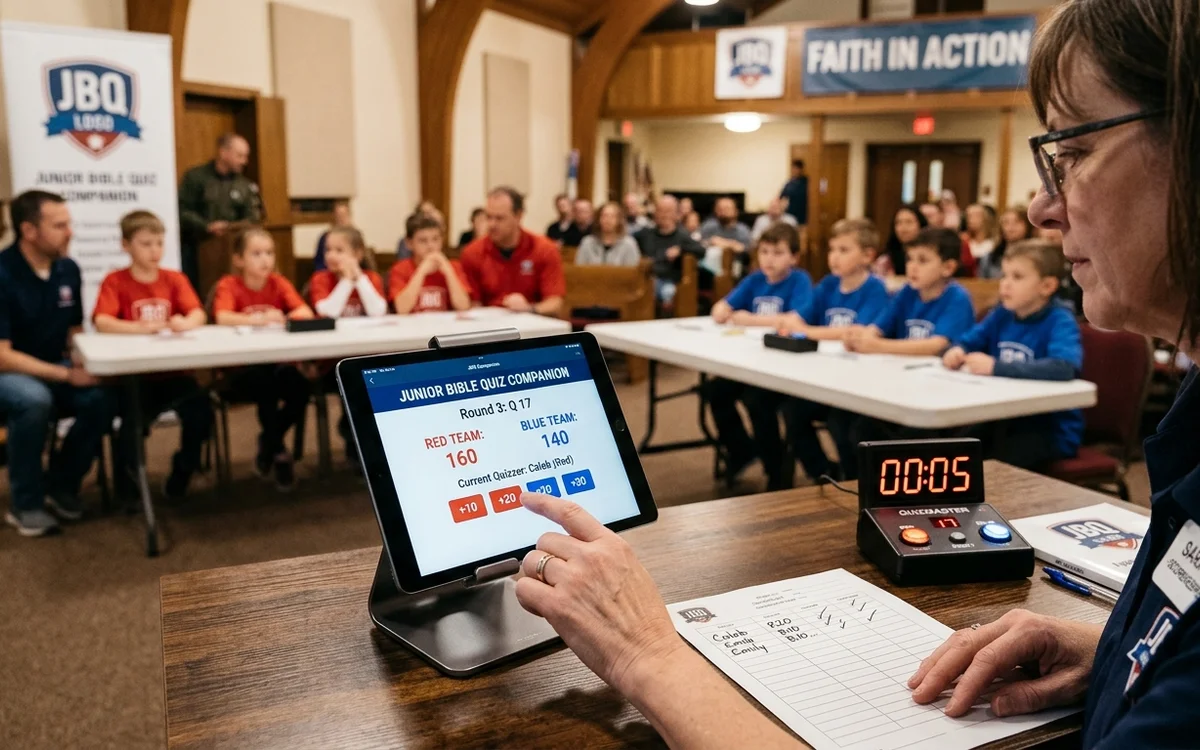
The JBQ Companion Scorekeeper module records match scoring and helps scorekeepers track individual quizzer performance.
When a quizzer reaches a quiz-out, strike-out, or foul-out threshold, the application can display a notification alerting the user to the event.
For example, after the sixth correct response is recorded, the app can identify that the quizzer has quizzed out.
The scorekeeper can then immediately inform the quizmaster.
This is a useful example of technology supporting a real responsibility during a match.
Digital Alerts Depend on Accurate Input
The application can only calculate the correct status if results are entered accurately.
If a scorekeeper records a correct answer under the wrong quizzer, forgets to enter a foul, or marks an incorrect response as correct, the displayed status may be inaccurate.
Therefore, scorekeepers should still:
- Confirm that the correct quizzer was identified.
- Record the correct question value and result.
- Check any quiz-out, strike-out, or foul-out alert.
- Notify the quizmaster promptly.
- Ensure the eligible quizzer leaves before the next question begins.
The app supports the scoring process, but officials remain responsible for following the official guidelines.
12. What Happens After a Quizzer Leaves the Table?
A quizzer who has quizzed out, struck out, or fouled out is no longer eligible to answer questions in that match.
However, a team may be able to replace that quizzer.
Under the official guidelines, the head coach may immediately replace an exited quizzer with an inactive eligible quizzer without using a team timeout.
This distinction matters because normal substitutions and replacing an ineligible quizzer can follow different procedures.
For example, if Red Two quizzes out and an eligible inactive quizzer is available, the head coach may bring that substitute into the match according to the applicable rules.
If there is no eligible substitute, the team must continue with the remaining eligible participants, subject to the match rules.
Coaches should prepare substitution plans before the match so transitions can happen without unnecessary confusion (see our advice on avoiding common JBQ coaching mistakes).
13. Common Scorekeeping Mistakes to Avoid
- Mistake 1: Adding an Extra Strike-Out Penalty: A strike-out does not automatically subtract an additional 10 points. Only the deductions from incorrect responses apply.
- Mistake 2: Combining Fouls and Incorrect Answers: Three incorrect responses and three individual fouls are separate thresholds. Two incorrect responses plus one foul is not a strike-out.
- Mistake 3: Forgetting the Quiz-Out Bonus: A quizzer who answers six questions correctly earns 10 bonus points. The scorekeeper must include that bonus in the score.
- Mistake 4: Forgetting to Notify the Quizmaster: Accurately recording a sixth correct response is not enough if the quizmaster is not informed and the quizzer remains at the table.
- Mistake 5: Allowing an Ineligible Quizzer to Continue: A late-discovered exit can require multiple questions to be voided and replaced. Prevention is considerably easier than reconstructing the affected sequence.
- Mistake 6: Recording a Team Foul as an Individual Foul: A team foul affects the team's score but does not count toward an active quizzer's three-individual-foul threshold.
- Mistake 7: Assuming Every Foul Voids the Question: Different foul situations have different question-handling procedures. Some require a substitute question, while others allow the original response to be completed and then assess the foul.
14. Quick Reference for Coaches and Scorekeepers
Keeping this table available during practice can help new coaches and scorekeepers become more familiar with the rules.
For official competitions, refer to the complete rulebook whenever a special or disputed situation occurs.
Frequently Asked Questions
Can a quizzer quiz out after having incorrect answers?
Yes. A quiz-out depends on reaching six correct responses, provided the quizzer remains eligible to participate.
Does a quizzer need a particular number of total points to quiz out?
No. Quiz-out is based on six correct answers, not a particular final score.
Does a strike-out create an additional ten-point deduction?
No. The normal deduction from the third incorrect response applies, but there is no extra strike-out deduction.
Can a quizzer have two incorrect answers and two individual fouls?
Yes. Those counts remain separate, and the quizzer has not reached either three-count threshold.
Does a team foul count as an individual foul?
No. A team foul is recorded against the team.
Can a quizzer return after striking out?
No. A quizzer who has struck out is ineligible to continue answering during that match.
Can a coach replace someone who has quizzed out?
Yes. An eligible inactive quizzer may replace the exited quizzer without using a timeout, following the official guidelines.
What happens if a quiz-out is noticed several questions late?
If an ineligible quizzer remained in the match and was permitted to answer, the official guidelines require the affected questions read while that quizzer remained to be voided and replaced.
Can JBQ Companion prevent every scoring mistake?
No. It can help track scores and alert scorekeepers to exit thresholds, but correct data entry and official oversight remain necessary.
Final Thoughts
Quiz-outs, strike-outs, and individual fouls are fundamental parts of Junior Bible Quiz competition.
Understanding the rules helps parents follow matches, coaches prepare their teams, and scorekeepers record results accurately.
The most important principles are simple:
- Six correct answers lead to a quiz-out and bonus.
- Three incorrect answers lead to a strike-out.
- Three individual fouls lead to a foul-out.
- Those counts must be monitored independently.
Equally important, officials must recognize when a quizzer becomes ineligible and take the appropriate action before the next question.
A missed exit can create a much more complicated situation later in the match.
Good preparation, accurate scorekeeping, and clear communication among officials help prevent these problems.
Most importantly, competition procedures should support the broader purpose of Junior Bible Quiz: helping children grow in biblical knowledge, confidence, discipline, and Christian character.
About JBQ Companion
JBQ Companion helps parents, coaches, and quizmasters with Junior Bible Quiz preparation, question study, practice, and match scoring.
Its Scorekeeper module helps record scores and monitor quizzer performance, including notifications when exit thresholds are reached.
These features can make match administration more manageable while keeping officials focused on the children and the competition.
Learn more at www.jbqcompanion.com.
Official Reference
Assemblies of God — Junior Bible Quiz Official Quiz Guidelines (Updated July 2024)
https://jbq.ag.org/-/media/JBQ/Downloads/HelpfulFiles/2024-Guidelines.pdf
Relevant sections include Scoring, Quiz Outs, Strike Outs, and Foul Outs (page 7); Fouls (pages 8–9); Scorekeeper (page 12); and Voiding Questions (page 17).
This article is an educational explanation of selected JBQ guidelines. It does not replace the official rulebook. Unusual match situations should be handled by the authorized officials according to the complete guidelines.