
If you are attending a Junior Bible Quiz (JBQ) competition for the first time, the scoring system can seem confusing.
A quizzer answers a 20-point question correctly and earns 20 points. Another quizzer answers a 30-point question incorrectly and loses 15 points. Then, suddenly, a child receives a bonus and must leave the table.
Parents may wonder why these things happen.
New coaches and scorekeepers can also find it challenging to remember the different scoring rules, especially during a fast-paced match.
The good news is that the basic JBQ scoring system is straightforward once you understand the main rules.
This beginner's guide explains how scoring works, what happens when a question is answered incorrectly, and why quizzers sometimes leave a match before all the questions have been asked.
Official rule source: The explanations in this guide are based on the Junior Bible Quiz Official Quiz Guidelines (updated July 2024), published by Assemblies of God.
1. Understanding the Three JBQ Question Levels
Junior Bible Quiz uses three distinct question levels:
- 10-point questions
- 20-point questions
- 30-point questions
Each question has a specific value, and the points earned or lost depend on that value.
The basic rule is simple:
A correct answer earns the full point value. An incorrect answer loses half of the question's value.
For example, if a quizzer answers a 20-point question correctly, the quizzer and their team receive 20 points.
If that quizzer answers a 20-point question incorrectly, 10 points are deducted.
The same calculation applies to 10-point and 30-point questions.

How Many Questions Are in a Match?
A standard JBQ match contains 20 questions (see our guide on starting a JBQ ministry for an overview of match day structure):
These 330 points represent the combined value of the scheduled questions. Actual team scores also depend on which team answers, incorrect responses, bonuses, fouls, and any overtime.
The questions follow official distribution requirements rather than being presented simply from the lowest point value to the highest.
2. How Individual JBQ Scores Are Calculated
Each quizzer has an individual score.
The score increases when the quizzer answers correctly and decreases when the quizzer answers incorrectly or receives an individual foul.
Consider a quizzer named Daniel:
Daniel's individual score is now 35 points.
Although Daniel answered three questions correctly, his incorrect 30-point response reduced his total.
This is why coaches should pay attention to both the number of correct responses and the points lost through mistakes (see our companion article on common JBQ coaching mistakes and how to avoid them).
A quizzer who answers carefully may contribute more than one who buzzes frequently but gives several incorrect responses.
What About Team Scores?
The team score includes the points earned or deducted through its quizzers, together with any applicable bonuses and team fouls.
For example:
In this simplified example, the combined individual scores total 140 points.
If the team also receives a separate team foul, that deduction must be included when calculating the final team score.
Individual scores and team scores are related, but they are not always identical in how deductions are recorded.
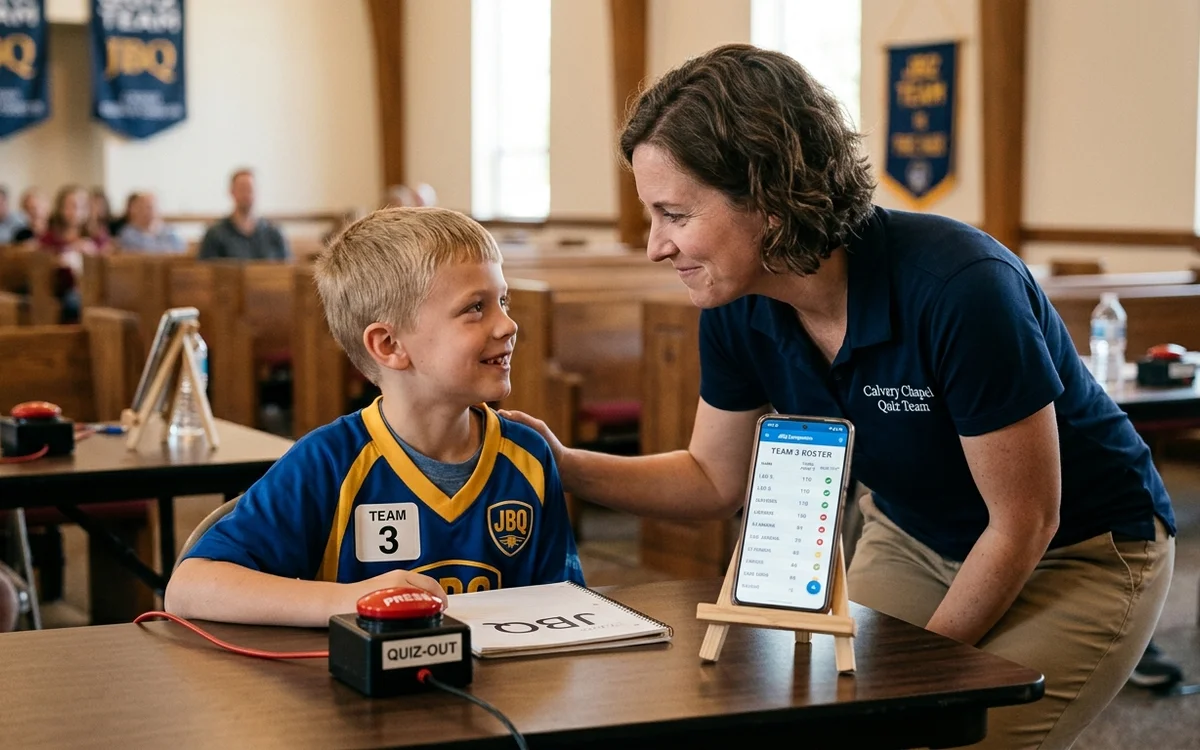
3. What Is a Quiz-Out in Junior Bible Quiz?
One of the most exciting moments in a JBQ match is when a quizzer earns a quiz-out.
A quiz-out happens when a quizzer answers six questions correctly in the same match.
When this happens:
- The quizzer receives the points for the sixth correct answer.
- An additional 10-point quiz-out bonus is awarded.
- The quizzer must leave the active quiz table.
Quiz-Out Example
Suppose a quizzer correctly answers these six questions:
The quizzer finishes with 130 points in this example, assuming no other deductions.
The important rule is that a quizzer quizzes out after six correct responses, not after reaching a particular total score.
A quizzer can quiz out with a different point total depending on the values of the questions answered and any previous deductions.
Remember: Six correct answers means a quiz-out, a 10-point bonus, and leaving the table.
4. What Is a Strike-Out or Negative Quiz-Out?
Another situation parents often misunderstand is when a quizzer must leave after answering three questions incorrectly.
The official JBQ term is strike-out.
Some participants informally call this a negative quiz-out, but strike-out is the term used in the official guidelines.
A strike-out occurs when a quizzer gives three incorrect responses during the match.
Strike-Out Example
Suppose a quizzer answers these questions incorrectly:
After the third incorrect response, the quizzer must leave the table.
A Common Scoring Mistake: Some beginners mistakenly believe that a strike-out creates an additional 10-point penalty. That is incorrect. There is NO extra 10-point strike-out deduction.
The quizzer loses the normal half-value deduction for each incorrect answer and then leaves the match after the third incorrect response.
In the example above, the total deduction is 30 points—not 40 points.
This is a particularly important distinction for new scorekeepers and quizmasters.
5. Understanding Individual Fouls and Foul-Outs
Incorrect answers are not the only reason a quizzer can lose points.
The official guidelines also include individual fouls.
An individual foul generally results in a five-point deduction from the quizzer's individual score.
Examples include:
- Buzzing during the opening announcement of a question, before the question itself begins.
- Beginning to respond before being identified by the official.
- Responding when another quizzer was identified.
- Improper communication or helping another quizzer.
- Certain actions or behavior determined to violate the competition rules.
A quizzer who receives three individual fouls has fouled out and must leave the match.
Do Incorrect Answers and Individual Fouls Combine?
No.
This is one of the most useful rules for beginners to understand.
Incorrect responses and individual fouls are tracked separately.
For example, suppose a quizzer has:
- Two incorrect answers.
- Two individual fouls.
The quizzer has accumulated deductions, but has not yet struck out or fouled out.
A third incorrect answer would cause a strike-out.
A third individual foul would cause a foul-out.
Two incorrect answers plus one individual foul do not count as three incorrect answers.
Similarly, two fouls plus one incorrect answer do not count as three fouls.
The three incorrect responses and three individual fouls are separate thresholds.
6. Three Different Ways a Quizzer May Leave the Match
The easiest way to remember these rules is to compare them directly:
These events have different meanings and should not be confused.
A quiz-out recognizes six successful answers.
A strike-out results from three incorrect responses.
A foul-out results from three individual fouls.
In each case, the quizzer is no longer eligible to continue answering questions in that match.
7. What Is an Interruption?
In Junior Bible Quiz, children do not always wait for the quizmaster to finish reading a question.
A quizzer may recognize the question early and activate the buzzer before the question is completed.
This is called an interruption.
Under the official guidelines, an interruption occurs when the quizzer buzzes after the opening remarks but before the final word of the question has been formed.
The quizmaster stops reading and identifies the quizzer.
The quizzer must then complete the interrupted question and provide the answer within the applicable response time (see our dedicated guide on how to improve buzzer speed and accuracy in JBQ).
Is Interrupting a Question Automatically Wrong?
No.
Interruptions are a normal part of Junior Bible Quiz competition.
A quizzer may interrupt correctly because they recognize the question early.
However, buzzing too soon increases the risk of confusing questions with similar wording.
For example, consider these official 10-point questions:
- How many books are there in the Bible? — 66
- How many books are in the Old Testament? — 39
- How many books are in the New Testament? — 27
All three begin similarly.
If a quizzer buzzes before hearing enough information, the quizzer may provide the answer to the wrong question.
This is why buzzer practice should focus on both speed and accuracy (learn more in our 10 practical JBQ coaching strategies).
8. What Happens When an Interrupted Answer Is Incorrect?
An incorrect interruption has an important consequence.
When a quizzer interrupts a question and gives an incorrect response, the normal half-value deduction applies.
The interrupted question is then generally reread to the opposing team, unless it was a question intended for only one team or another specific rule applies.
Example: Incorrect 20-Point Interruption
Suppose Team Red interrupts a 20-point question.
Red Two gives an incorrect response.
Red Two loses 10 points.
The quizmaster rereads the question to Team Green.
If a Green quizzer answers correctly, Team Green earns the full 20 points.
This creates a 30-point swing in the difference between the two team scores.
That is why premature interruptions can be costly.
Does Every Incorrect Answer Cause a Reread?
No.
The reread procedure depends on whether the question was interrupted and on the applicable question and match rules.
An incorrect answer to a question that was not interrupted does not automatically create the same reread opportunity.
The more detailed interruption, reread, and substitute-question procedures will be covered in a separate advanced JBQ rules article.
9. What Are Team Fouls?
In addition to individual fouls, Junior Bible Quiz has team fouls.
A team foul generally involves improper actions by a coach or an inactive quizzer, rather than an active quizzer.
Examples may include improper communication or providing assistance to an active quizzer.
A team foul results in a five-point deduction from the team's score.
This is different from an individual foul, which affects the active quizzer's individual score.
The distinction matters when keeping accurate scores.
For example, if a coach improperly helps an active quizzer, the official may assess a team foul under the applicable guidelines.
That should not automatically be recorded as an individual incorrect answer for the child (for guidelines on handling coaching friction constructively, see our guide on handling parent conflicts in Junior Bible Quiz).
Team fouls, interference, wrong-quizzer responses, and substitute questions involve additional procedures. We will explain them separately in a more advanced guide.
10. What Happens When a Match Ends in a Tie?
A standard Junior Bible Quiz match ends after 20 questions unless the teams are tied.
If the team scores are equal, the match proceeds to overtime.
Under the July 2024 guidelines:
- The match is officially reopened and a one-minute timeout is declared.
- The first overtime period contains three additional questions: one 10-point, one 20-point, and one 30-point question, in random order.
- If the match remains tied, additional 20-point sudden-death overtime periods continue as needed.
The usual scoring principles still apply during overtime, along with the specific overtime procedures.
Because overtime contains additional rules, coaches and officials should consult the official guidelines whenever a situation requires a ruling.
11. How JBQ Companion Helps With Scorekeeping
Keeping track of individual scores, team scores, incorrect answers, fouls, and quiz-outs can be challenging during a fast-paced match.
Traditionally, churches may use paper score sheets and multiple people to monitor the results.
Digital scorekeeping can simplify this work.
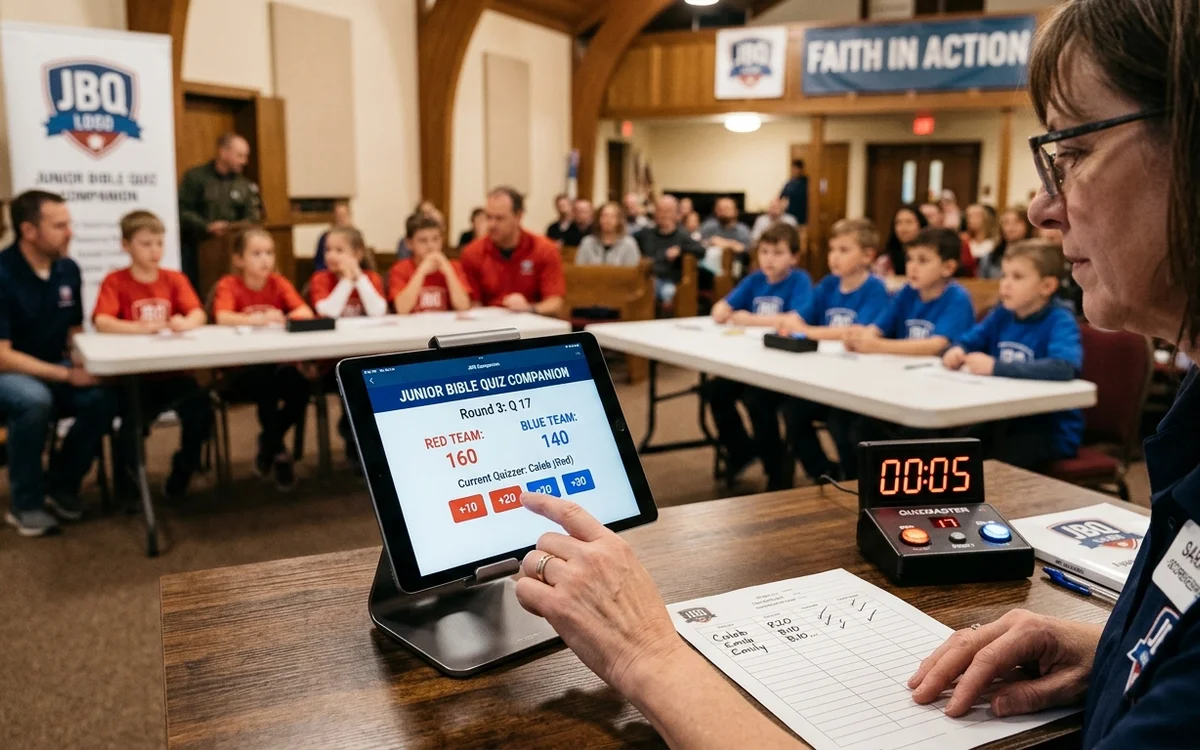
The JBQ Companion Scorekeeper module helps scorekeepers record match performance, calculate scores, and monitor quizzer progress.
For example, the app can display an alert when a quizzer reaches the required number of correct answers, incorrect answers, or individual fouls.
This helps the scorekeeper recognize when a quizzer must leave the table.
Why Accurate Entry Still Matters
Even with a digital application, the scorekeeper must enter each result correctly.
If a response is entered for the wrong quizzer or recorded with the wrong result, the application may calculate an incorrect score.
The scorekeeper remains responsible for monitoring the match and informing the quizmaster when a quizzer has quizzed out, struck out, or fouled out.
Technology supports accurate scorekeeping, but the official guidelines and match officials remain the authority.
For parents and coaches, reviewing practice scores can also help identify strengths and areas that need additional preparation (read our suggestions on improving communication between coaches and parents).
Common Junior Bible Quiz Scoring Questions
Does a quizzer get an extra penalty for a strike-out?
No. The quizzer receives the normal deduction for the third incorrect answer but does not receive a separate strike-out penalty.
Does a quizzer receive bonus points for a quiz-out?
Yes. After six correct responses, the quizzer receives a 10-point bonus and leaves the match.
Do two incorrect answers and one foul cause a strike-out?
No. Incorrect answers and individual fouls are counted separately.
Can a quizzer have a negative individual score?
Yes. Deductions can exceed points earned.
Is an interruption automatically a foul?
No. Interrupting after the opening remarks and during the reading of the question is permitted. An incorrect response may result in a deduction and a reread.
Who should tell the quizmaster when someone quizzes out?
The scorekeeper is responsible for tracking the count and notifying the quizmaster when a quizzer reaches a quiz-out, strike-out, or foul-out threshold.
Can an eligible substitute replace a quizzer who has left the table?
Yes, subject to the official eligibility and substitution rules. A quizzer who has quizzed out, struck out, or fouled out cannot return as an active quizzer in that match.
Final Thoughts
Understanding Junior Bible Quiz scoring makes competitions easier to follow for parents, coaches, and new scorekeepers.
The most important rules to remember are straightforward:
- Correct answers earn the full point value.
- Incorrect answers lose half the question value.
- Six correct answers produce a quiz-out and a 10-point bonus.
- Three incorrect answers produce a strike-out without an additional strike-out penalty.
- Three individual fouls produce a foul-out.
- Incorrect answers and individual fouls are counted separately.
Once these fundamentals are understood, more complex situations involving interruptions, rereads, substitute questions, appeals, and unusual match events become easier to follow.
Above all, Junior Bible Quiz is about more than earning points.
It gives children an opportunity to study God's Word, practice discipline, develop confidence, demonstrate good sportsmanship, and grow together through Christian fellowship.
Understanding the rules helps everyone concentrate on what matters most: encouraging children to learn, love, and live God's Word.
About JBQ Companion
JBQ Companion is a mobile application designed to support Junior Bible Quiz learning, practice, and match scoring.
Its Learn module helps families prepare questions, while the Scorekeeper module supports recording match results and monitoring quizzer performance.
The application can complement regular church practice and official scorekeeping procedures.
Learn more at www.jbqcompanion.com.
Official Reference
Assemblies of God — Junior Bible Quiz Official Quiz Guidelines (Updated July 2024)
https://jbq.ag.org/-/media/JBQ/Downloads/HelpfulFiles/2024-Guidelines.pdf
This beginner's guide summarizes selected official JBQ rules for educational purposes. For unusual situations, rulings, and official competitions, consult the complete current guidelines and applicable district instructions.