In Junior Bible Quiz (JBQ), knowing the correct answer is only part of successful competition.
A quizzer may have memorized every assigned question but still struggle during a match because another child recognizes the question faster and activates the buzzer first.
On the other hand, a quizzer may be extremely fast with the buzzer but lose valuable points by interrupting before identifying the correct question.
This creates one of the most important challenges for JBQ parents and coaches:
How can we help children improve their buzzer speed without sacrificing accuracy?
The answer is not simply to encourage children to buzz faster. Effective buzzer training combines strong question memorization, careful listening, question recognition, physical buzzer practice, and good judgment.
Here are ten practical techniques parents and coaches can use to develop both speed and accuracy.
1. Build Strong Question Knowledge Before Focusing on Speed
Before concentrating on buzzer speed, children need to know their assigned questions and answers confidently.
When a quizzer is still struggling to remember an answer, rushing to activate the buzzer can increase pressure and lead to incorrect responses.
During the initial learning stage, parents and coaches should focus on helping children:
- Memorize the assigned questions (see our guide on how to memorize JBQ questions effectively).
- Understand which question matches each answer.
- Recall answers without assistance.
- Become comfortable with the complete wording.
- Recognize questions when they are presented in a different order.
For beginners, a few well-learned questions are more useful than many questions they can answer only with hints (read more about practicing with beginners and experienced quizzers together).
Once children can answer their assigned questions consistently, coaches can gradually introduce faster recognition and buzzing exercises.
Accuracy provides the foundation. Speed develops through familiarity and focused practice.
2. Teach Children to Recognize the Beginning of a Question
Experienced JBQ quizzers often recognize questions before the quizmaster finishes reading them.
They become familiar with the specific wording, structure, and opening phrases of the official JBQ question bank.
Parents can help children develop this skill during home practice.
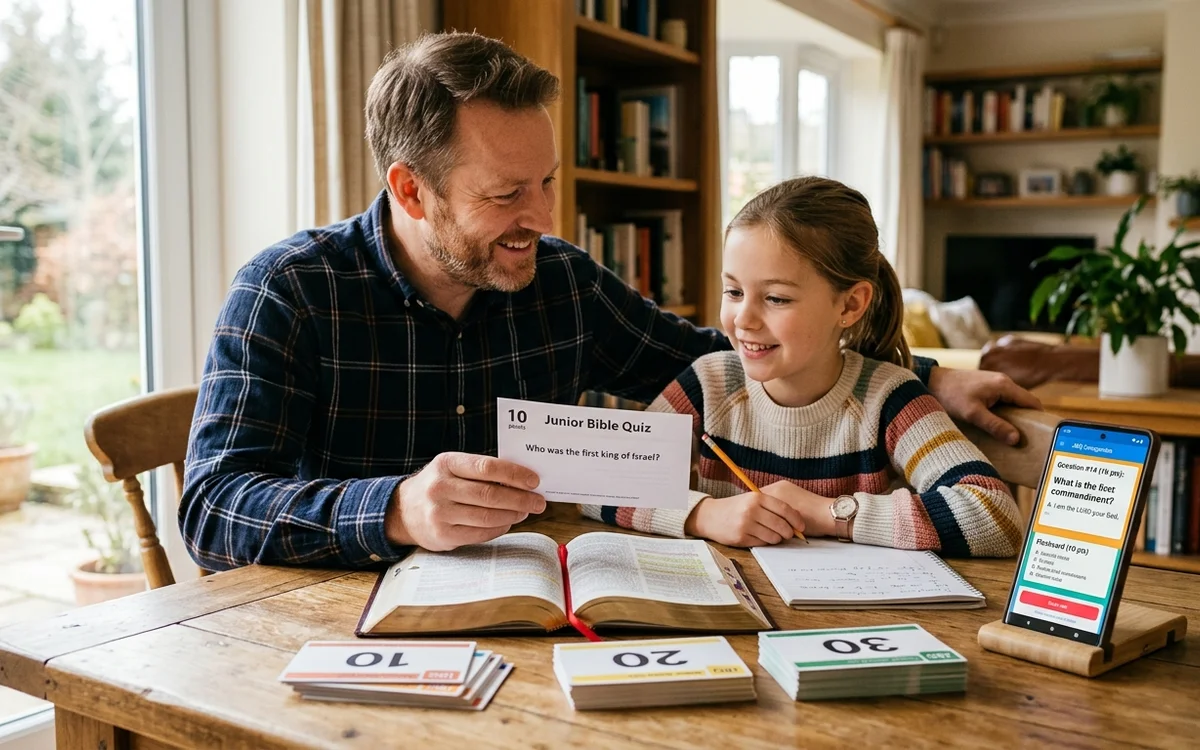
Instead of always reading the complete question, occasionally announce the point value and read only the beginning.
For example, using these official 10-point questions:
Question: How many books are there in the Bible?
Answer: 66.
Question: How many books are in the Old Testament?
Answer: 39.
Question: How many books are in the New Testament?
Answer: 27.
These questions have similar openings, but their answers are different.
A quizzer who hears only “How many books...” does not yet have enough information to identify the correct answer.
They must listen for the distinguishing words: Bible, Old Testament, or New Testament.
This demonstrates an important lesson: fast recognition is valuable only when the quizzer has heard enough information to identify the correct question.
A Simple Recognition Exercise
During practice:
- Announce the question's point value.
- Begin reading the official question.
- Stop at a natural point.
- Ask the child which question they recognized.
- Continue reading if more than one question matches the opening.
Over time, children learn which question openings are unique and which require additional listening.
3. Practice Similar Questions Together
One of the most effective ways to prevent incorrect interruptions is to practice questions with similar wording together.
When children memorize questions in numerical order, they may remember them primarily by sequence.
During an actual match, however, they need to recognize questions independently.
Coaches should identify questions that begin with similar words and practice them as a group.
For example, the three questions about the total number of books in the Bible, Old Testament books, and New Testament books provide a useful recognition exercise.
- Read each question in a different order.
- Sometimes pause early, and sometimes continue until the distinguishing phrase becomes clear.
- Ask children to explain which words helped them recognize the question.
This develops careful listening rather than guessing.
It can also be useful to mix quotation and non-quotation questions during advanced review when the assigned question sets contain both.
The objective is to recognize the correct question—not merely recognize a familiar phrase.
4. Practice With Questions in Alphabetical Order
Many children initially learn their assigned JBQ questions in numerical order.
This can be helpful during memorization because it provides a predictable sequence.
However, once children become comfortable with the questions, coaches should introduce other arrangements.
Alphabetical-order practice is especially useful.
When questions are organized alphabetically, children may encounter several questions with similar beginnings close together.
For example, multiple questions may begin with “How did,” “Who was,” or “What is.”
This helps children notice similarities and learn to identify the words that make each question distinct.
A Practical Weekly Approach
During weekday reviews, parents can focus on questions that are still difficult (explore our realistic JBQ practice plans for busy families).
On weekends, a longer practice session can review the complete assigned set in alphabetical order.
Announce each question's point value before reading it.
This approach helps children transition from memorizing answers to recognizing questions more quickly.
Always use the actual official JBQ questions assigned for the relevant meet.
5. Teach When to Buzz—and When to Wait
One of the biggest mistakes in Junior Bible Quiz is confusing fast buzzing with good buzzing.
A quizzer who interrupts before hearing enough information may give an answer that belongs to a different question.
This is especially common when several questions have similar openings.
Coaches should teach children to distinguish between two situations:
- Situation A: The question is clearly recognized. The quizzer has heard enough wording to identify the question confidently and knows the answer.
- Situation B: Several questions remain possible. The quizzer recognizes a familiar opening but has not yet heard the words needed to identify the correct question.
In the second situation, waiting for more information may be the better strategy.
Core coaching principle: Buzz when you recognize the question, not simply because you recognize the first few words.
This does not mean children should always wait until the entire question is read.
It means they should learn to balance speed with confidence.
6. Simulate Real Quizmaster Reading and Interruptions
During home practice, parents often read questions slowly and clearly.
This is useful when children are learning.
However, quizmasters may read questions at different natural speeds, and an interruption may occur at any point while a question is being read.
Advanced practice should help children become comfortable with those conditions.
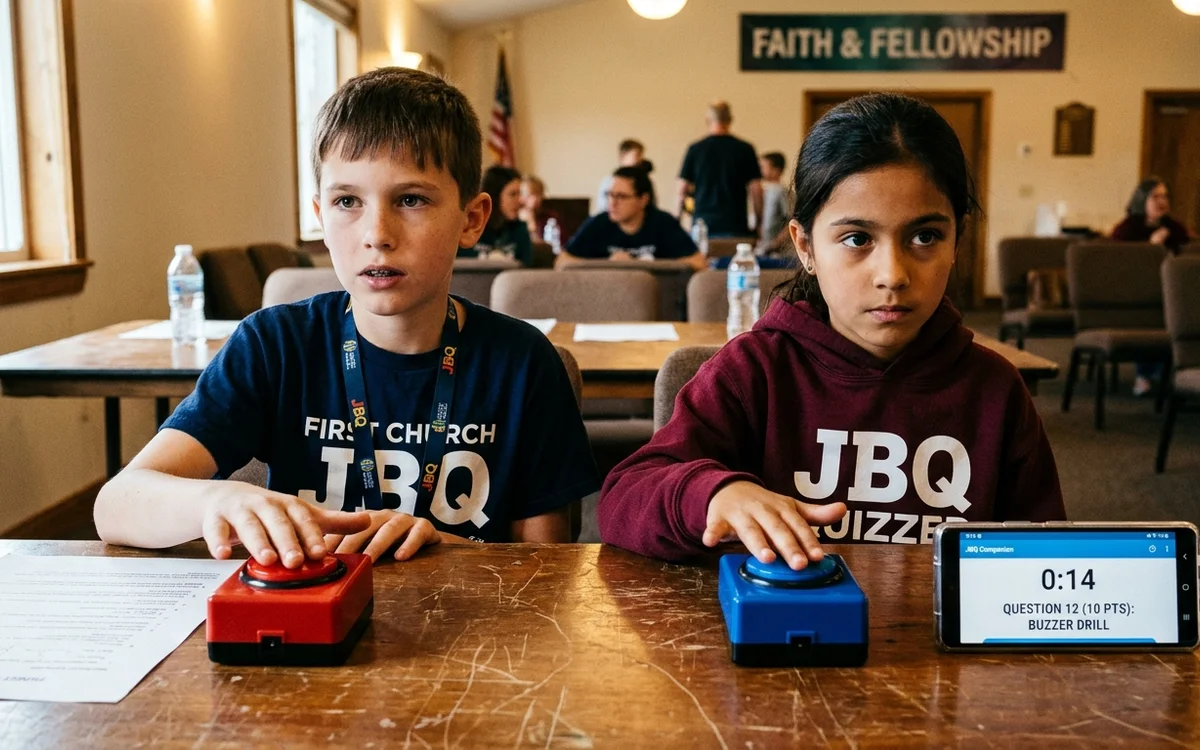
Parents can act as quizmasters and read official questions aloud.
When the child activates the practice buzzer, the parent stops reading immediately.
The quizzer then responds according to the applicable JBQ practice procedure.
For an additional recognition exercise, the parent can sometimes stop unexpectedly partway through a word and ask the child whether they can confidently identify the question.
This is a training technique to develop recognition from incomplete wording, not a replacement for official interruption procedures.
Why This Matters
Children who practice only with fully read questions may struggle when other quizzers interrupt early.
By introducing interrupted-question exercises gradually, coaches can help children become more comfortable with realistic competition conditions.
Begin with familiar questions and increase the difficulty as the child improves.
7. Improve Physical Buzzer Technique
Question recognition is only one part of buzzer performance.
Children also need to become comfortable using the physical buzzer.
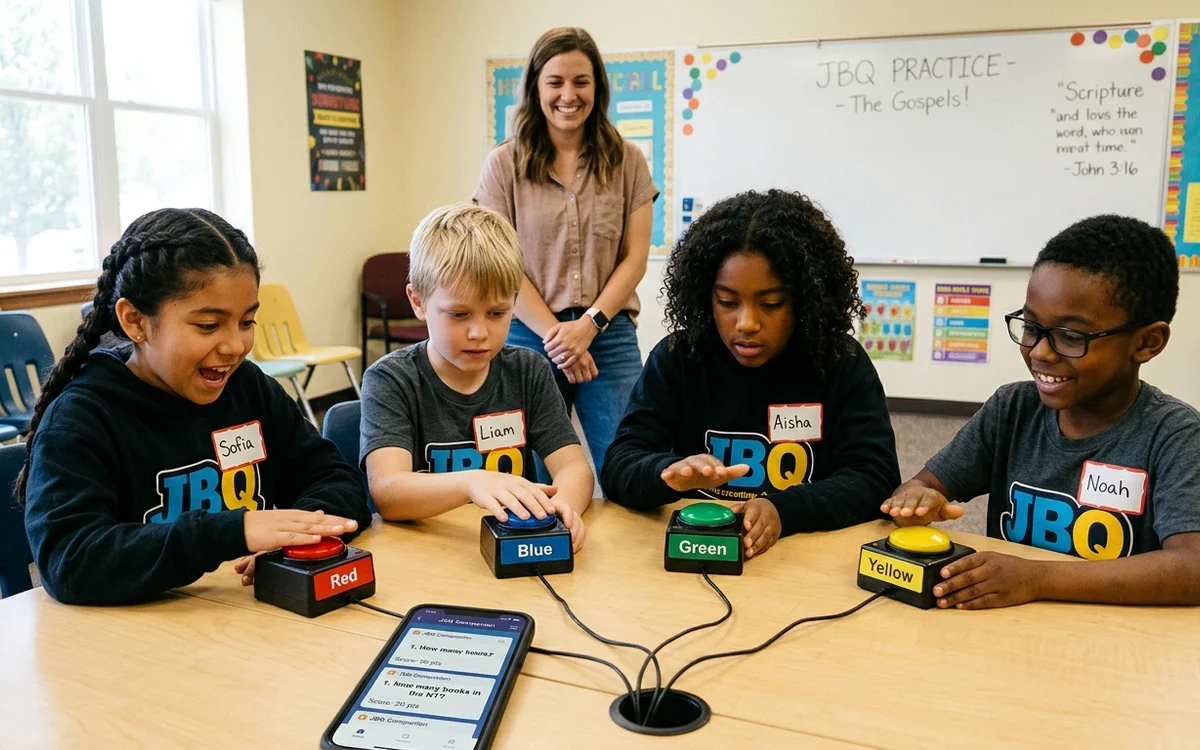
Individual practice buzzers can help children develop familiarity without requiring a complete quiz box.
For younger children, even pressing the buzzer comfortably may take practice (see our coaching tips in 10 practical JBQ coaching strategies).
Coaches should pay attention to:
- How the child holds or positions the buzzer.
- Whether the activation button requires significant pressure.
- The child's seating position and table height.
- Whether the child can activate the buzzer without excessive movement.
- Whether the buzzer is positioned consistently during practice.
For shorter children, a safe and stable seating adjustment can help them reach the table comfortably.
Where practical, home practice should resemble the actual church practice environment.
The goal is to make buzzer operation feel natural so children can concentrate on the question instead of the equipment.
Good buzzer technique reduces unnecessary movement and supports consistent responses.
8. Use JBQ Companion for Question Recognition and Home Practice
Technology can make question practice more convenient, especially for families with busy schedules.
The JBQ Companion Learn module helps parents and quizzers organize question preparation and review assigned material.
Parents can focus on questions for a specific meet and point value, allowing children to practice material appropriate to their level.
The app's audio playback options can also help children become familiar with the exact wording of questions.
Combine Audio Practice With Buzzer Practice
A useful approach is to separate learning into two activities:
- Listening and recognition: Use the Learn module to review the selected question set. Allow the child to hear the questions repeatedly, particularly those they find difficult.
- Active buzzer practice: Use the same official question set for a parent-led buzzer session. Read questions in a different order, pause when the child buzzes, and evaluate the answer.
This combination helps connect familiar question wording with the physical act of buzzing and answering.
For families practicing together, the JBQ Companion virtual quiz box can also provide a way to practice buzzer participation using supported mobile devices.
Use the app features that fit the family's available equipment and learning needs.
The aim is to make practice more effective—not to increase screen time unnecessarily.
9. Reduce Negative Points Through Controlled Practice
A child may recognize many questions but still receive repeated negative points during competitions because of premature interruptions.
When this happens, simply telling the child to buzz faster or study harder may not solve the problem.
Coaches should identify the reason for incorrect answers:
- Did the quizzer confuse two similar questions?
- Did they recognize the question but forget the answer?
- Did they buzz without enough information?
- Did they become nervous under competition pressure?
- Did they answer too quickly without organizing their response?
Each problem requires a different kind of practice.
If the problem is similar question wording, focus on recognition exercises.
If the problem is incomplete memorization, return to question review.
If the problem is rushing, encourage the quizzer to wait for a clearer identifying word (see our guide on common JBQ coaching mistakes and how to avoid them).
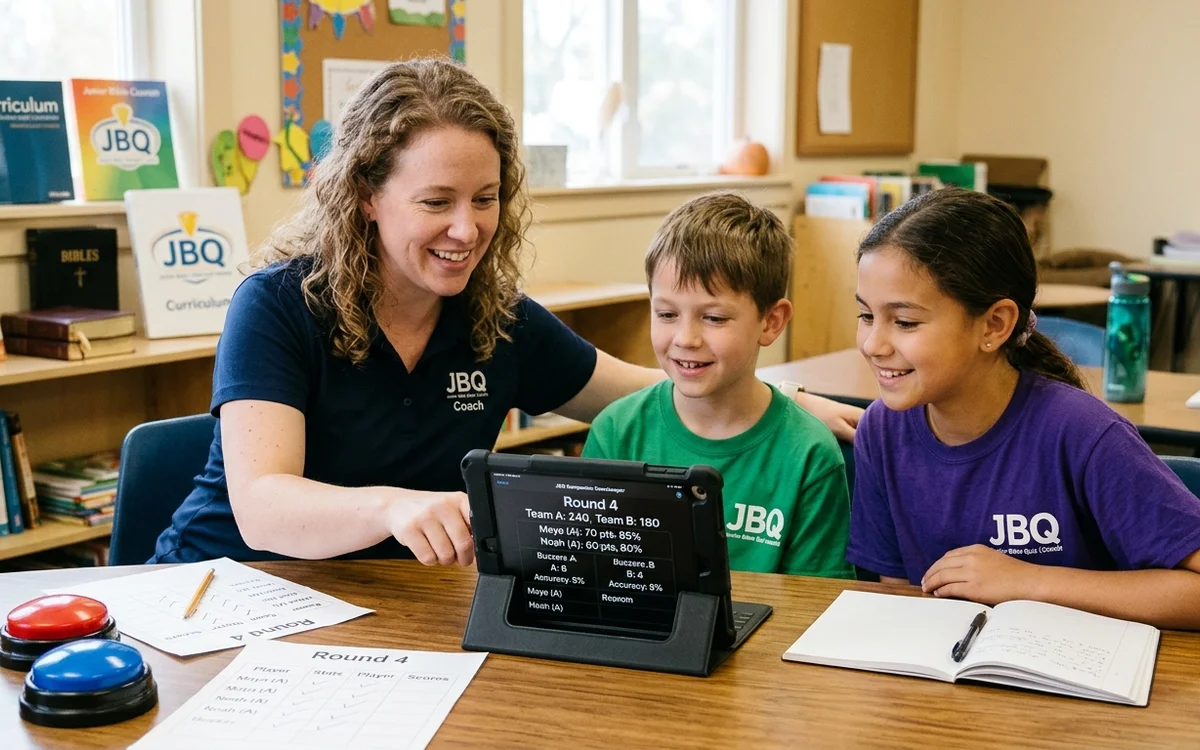
Using Match Results Constructively
The JBQ Companion Scorekeeper module can help coaches review correct and incorrect responses during practice matches.
A coach may notice that a quizzer earns many points but repeatedly loses points through incorrect interruptions.
Rather than criticizing the child, the coach can use that information to identify a specific improvement goal.
For example:
“During the next practice, concentrate on hearing the distinguishing words before buzzing.”
An improvement in accuracy can be just as valuable as an improvement in speed.
10. Adjust Buzzer Strategy Based on the Match
Not every JBQ match requires exactly the same buzzing strategy.
Some opposing teams may have very fast quizzers. Others may allow more time before activating the buzzer.
Coaches should help children understand that they do not need to approach every match with the same level of aggression.
One practical strategy is to begin a match with controlled buzzing while observing the opposing team's speed and accuracy.
During the first few questions, encourage children to listen carefully and avoid unnecessary risks.
As the match develops, coaches can assess whether the team needs a faster approach or should continue prioritizing accuracy.
Any changes in strategy should be communicated through permitted coaching opportunities under the official guidelines (see our advice on improving communication between coaches and parents).
Avoid Prejudging the Opponent
A team with a strong reputation is not guaranteed to win every match.
Similarly, a less experienced team should not be underestimated.
Overconfidence can lead to careless interruptions, while excessive fear can cause children to hesitate even when they know the answer.
Encourage quizzers to concentrate on the question in front of them rather than worrying about the opposing team's reputation.
A good buzzing strategy combines preparation, accuracy, confidence, and awareness of the match situation.
A Simple 15-Minute Buzzer Practice Routine
Parents and coaches can use a short practice session to improve recognition and accuracy without overwhelming children.
This is a sample routine rather than a required schedule.
Beginners may need more time for memorization and less time for fast interruptions.
Experienced quizzers may benefit from more challenging question-recognition drills and realistic match practice.
Adjust the routine to the child's current level.
Common Buzzer Practice Mistakes to Avoid
Even when children practice regularly, certain habits can slow their progress.
- Buzzing before recognizing the question: Familiar opening words do not always identify a unique question.
- Practicing only in numerical order: Mix the question order after the initial memorization stage.
- Prioritizing speed over accuracy: Faster buzzing is not useful when it repeatedly leads to incorrect answers.
- Ignoring physical buzzer comfort: Children should be comfortable with their buzzer position and equipment.
- Practicing only easy questions: Similar openings and difficult questions deserve additional attention.
- Treating negative points as failure: Use mistakes to identify specific training needs.
- Giving the same strategy to every quizzer: Beginners and experienced quizzers may need different drills.
- Practicing without realistic interruptions: Introduce partial-question practice once the assigned material is familiar.
Final Thoughts: The Best Buzzer Is Both Fast and Accurate
Improving buzzer performance in Junior Bible Quiz requires more than quick reflexes.
Children must learn the official questions, recognize their unique wording, listen carefully, use the buzzer comfortably, and develop confidence in their answers.
Parents and coaches can support this process through short, consistent practice sessions, alphabetical-order reviews, similar-question drills, audio learning, and realistic buzzer exercises.
Some quizzers will naturally become faster than others.
However, every child can improve through focused preparation and encouragement.
The ultimate objective is not simply to press the buzzer first.
The goal is to recognize the correct question, respond confidently, and demonstrate the Bible knowledge the child has worked hard to learn.
About JBQ Companion
JBQ Companion provides tools to help parents, coaches, and quizzers prepare for Junior Bible Quiz.
Its Learn module supports question study and audio-based review. The Scorekeeper module helps record match performance, while the virtual quiz box supports buzzer practice using compatible mobile devices.
These tools can complement regular home learning and church practice.
Learn more at www.jbqcompanion.com.
The exercises in this article are coaching suggestions. Practice techniques such as stopping midword or using special training restrictions are not substitutes for official JBQ competition procedures. Always follow the applicable Junior Bible Quiz guidelines during official matches.