

Communication is one of the most important parts of a successful Junior Bible Quiz (JBQ) ministry.
Children may spend hours learning Bible questions at home, but parents need to know what to study, when practices are scheduled, how their children are progressing, and what to expect at upcoming quiz meets.
At the same time, coaches and coordinators often balance JBQ responsibilities with work, family commitments, and other church activities.
Without an effective communication system, even a well-organized ministry can face misunderstandings, missed updates, and unnecessary last-minute complications.
The good news is that communication does not have to be complicated. A few consistent practices can make a significant difference.
Here are ten practical strategies for improving communication between JBQ coaches, coordinators, and parents.
1. Choose a Communication Method Parents Actually Use
One of the first decisions for a JBQ ministry is how to communicate with parents.
Some churches rely on email. Others use text messages, WhatsApp groups, or church communication platforms.
Email can work well for official announcements and documents, but it may not be the most effective way to communicate time-sensitive information.
Group messaging platforms, such as WhatsApp, can make it easier to share quick reminders and receive responses.
For example, a coordinator might send:
“Reminder: JBQ practice is tomorrow after church. Please let us know if your child has any scheduling difficulties.”
Parents can respond directly without searching through lengthy email conversations.
The best communication platform is the one that parents can access easily and will use consistently.
Choose a method that suits your church community, establish clear expectations, and keep important information in one primary location.
2. Create a Dedicated JBQ Parent Communication Group
A dedicated group can help keep JBQ information organized.
Instead of contacting every parent separately for routine announcements, coaches or coordinators can send one message to the entire group.
The group can be used to communicate:
- Weekly practice schedules.
- Upcoming quiz meet dates and locations.
- Changes to practice times.
- Learning assignments and deadlines.
- Important announcements from district coordinators.
- Transportation or other logistical updates.
Keeping these updates together makes information easier to find.
However, avoid overwhelming the group with unnecessary messages.
For sensitive matters involving one child's progress, behavior, or attendance, use direct communication instead of discussing them publicly.
Communication guideline: Group messages are useful for shared information. Individual conversations are better for personal concerns.
Before creating a group, ensure parents are comfortable with the platform and understand that other members may be able to see their phone numbers.
3. Share a Clear Weekly Question-Learning Schedule
Parents are more likely to support their children's preparation when they know exactly what questions need to be learned.
Instead of simply telling families to practice more, provide a clear schedule (see our guide on realistic JBQ practice plans for busy families).
For example, suppose a group of beginners has approximately 50 assigned questions to learn over five weeks.
The coach can divide the questions into manageable weekly sets.
The exact number of questions may differ depending on the child's age, experience, and assigned point values.
A beginner learning 10-point questions may have a different workload from an experienced quizzer preparing for 20-point or 30-point questions (read more about practicing with beginners and experienced quizzers together).

Why Cumulative Practice Matters
During the first week, coaches can focus on the questions children were assigned to learn.
During the second week, practice includes both the first and second weeks' material.
As the schedule progresses, each practice covers an increasing portion of the assigned questions.
This helps prevent children from forgetting earlier material while learning new questions (explore proven techniques in our guide to memorizing JBQ questions effectively).
Once the full set has been introduced, the focus can shift toward revision, accuracy, question recognition, and buzzer practice.
A clear learning schedule gives parents a realistic goal and helps coaches measure progress consistently.
4. Share Progress Updates Instead of Waiting for Parents to Ask
Some parents regularly attend practices and ask questions about their children's performance.
Others may be unable to attend because of work, transportation, family commitments, or other responsibilities.
Coaches and coordinators should not depend entirely on parents initiating communication.
Regular updates help every family understand how their child is doing.
Useful progress information may include:
- Which assigned questions the child has learned.
- Which questions still need revision.
- Whether the child is becoming more comfortable with buzzing.
- Areas of improvement since the previous practice.
- A realistic goal for the coming week.
Updates do not need to be lengthy.
A short message identifying one strength and one area for improvement is often more useful than a general instruction to practice harder.
Remember that quiz scores are only one indicator of development. Confidence, listening, participation, and Scripture knowledge also matter.
5. Use JBQ Companion to Share Practice Match Results
Tracking quiz match results can help coaches identify progress and provide more specific feedback.
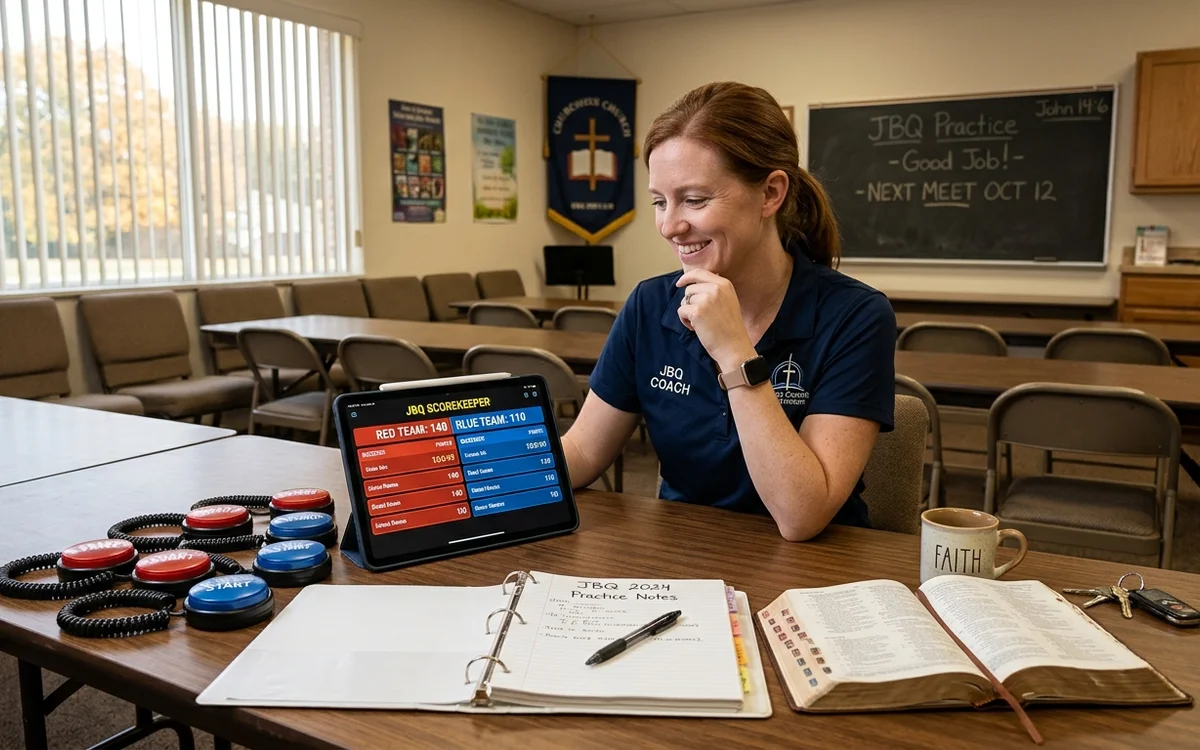
The JBQ Companion Scorekeeper module supports match scoring and can help leaders keep track of quizzer performance.
After a weekly practice match, coaches or coordinators can use the recorded results to prepare a simple progress update for parents.
For example:
“This week's practice went well. Your child answered several assigned questions confidently. Please spend extra time reviewing the quotation questions before our next practice.”
The purpose is not to rank children publicly or compare teammates.
Instead, recorded performance can help adults identify which areas need more attention (review our 10 practical JBQ coaching strategies for tips on analyzing quizzer strengths).
Share Results Constructively
When communicating results, focus on the individual child's development.
Avoid publicly discussing a child's low score or mistakes.
If an individual report or score summary is being shared, ensure it reaches the appropriate parent or guardian.
Use the Scorekeeper module to support useful conversations, rather than treating the score as the complete measure of a child's progress.
Meaningful feedback helps parents know what to do next.
6. Communicate Individually When a Child Needs Extra Support
Not every quizzer will follow the learning schedule at the same pace.
Some children complete assignments early, while others may need additional time.
When a child falls behind, the coach or coordinator should communicate privately with the parent.
This conversation can happen:
- After a regular church practice.
- Through a personal WhatsApp message.
- During a short telephone call.
- At another convenient time for both parties.
The conversation should be supportive and specific.
Rather than saying:
“Your child is behind everyone else.”
A coach could say:
“There are a few assigned questions that still need practice. Could you help review these questions at home this week? We can also work on them during the next practice.”
This approach gives parents clear information without making them or their children feel criticized.
It also provides an opportunity for parents to explain if schoolwork, illness, or other commitments have affected preparation.
The objective is to solve the learning problem together, not assign blame.
7. Communicate Before Quiz Meets Without Creating Unnecessary Pressure
As quiz meet dates approach, communication becomes especially important.
Parents may need information about the venue, transportation, reporting time, food arrangements, or other logistics.
A useful pre-meet message can include the essential details in one place.
For example:
“Our next JBQ quiz meet is this Saturday. Please review the location and arrival time shared above. If your child has an unexpected illness, transportation difficulty, or last-minute change, please let us know as soon as possible.”
Not every church needs formal attendance confirmation for every event.
In some church communities, participation is well established, and repeatedly asking parents to confirm may feel unnecessary.
In other situations—especially when transportation, meals, or team rosters depend on accurate numbers—confirmations may be helpful.
Churches should choose an approach that fits their own needs.
Encourage Early Notice of Changes
Even when attendance confirmations are not required, parents should know whom to contact if an unexpected issue arises.
Last-minute changes can affect team arrangements, transportation, food planning, and other families.
A simple request for early notification can reduce unnecessary complications without placing pressure on parents.
8. Use Reminders and Automation to Reduce Administrative Work
Coaches and coordinators often have several responsibilities beyond JBQ.
Sending the same practice reminder every week can become another task to remember.
A simple solution is to establish a consistent reminder routine.
For example:
- Send a reminder the day before practice.
- Include the practice time and any important changes.
- Mention the upcoming week's learning target when appropriate.
- Send additional announcements only when necessary.
Churches can manage these reminders manually or use scheduling and automation tools.
Some coordinators may choose to use digital assistants or automated messaging workflows to prepare recurring reminders.
However, advanced technology is not required.
Even a recurring phone reminder and a saved message template can make communication more consistent.
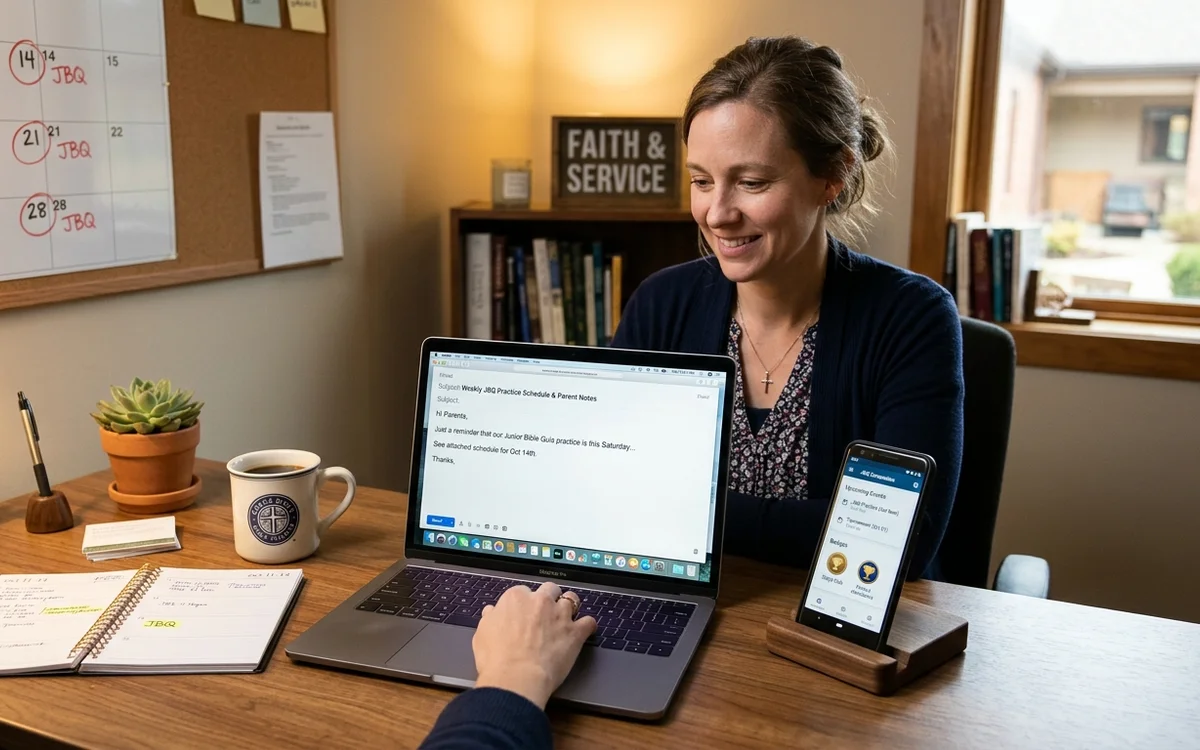
For automated or AI-assisted messages, review important details before sending, particularly when practice times, locations, or other arrangements can change.
Technology should reduce the coordinator's workload without making communication less personal.
9. Adapt Communication Responsibilities to the Size of Your Church
Every JBQ ministry operates differently (see our overview on how to start a Junior Bible Quiz ministry).
A smaller church may have one coordinator handling most responsibilities, including practices, communication, scoring, and scheduling.
This can work well when families know one another and communication is informal.
Larger churches may have several teams, multiple coaches, and more complex schedules.
In these environments, clearly defined responsibilities can prevent confusion.
These are examples, not mandatory organizational structures.
The important principle is that parents should know whom to contact for different kinds of questions.
For larger ministries, allowing coaches to handle routine team concerns first can make communication more efficient while leaving the coordinator available for broader issues.
10. Build a Communication Culture Based on Encouragement and Respect
Good communication involves more than sharing schedules and reports.
It also shapes the relationship between parents, coaches, coordinators, and children.
Parents may have different levels of availability and involvement.
Some regularly attend practice sessions, while others primarily support learning at home.
These differences should not automatically be treated as differences in commitment.
Coaches can strengthen relationships by:
- Communicating regularly without overwhelming families.
- Recognizing each child's improvement.
- Sharing specific, actionable learning goals.
- Listening when parents raise concerns.
- Discussing sensitive issues privately.
- Respecting different family schedules.
- Keeping conversations centered on the child's development and the ministry's purpose.
Disagreements about match decisions or team responsibilities should be handled respectfully through the appropriate coaching and coordination process.
For more detailed guidance, see our article, How to Handle Parent Conflicts in Junior Bible Quiz: A Practical Guide for Coordinators and Coaches.
When parents and coaches communicate well, children benefit from greater consistency between home preparation and church practice.
A Simple Weekly Communication Plan
Churches do not need to send messages every day to maintain effective communication.
A practical weekly routine might look like this:
The exact frequency should depend on the church's existing routine and what parents find useful.
For some ministries, one or two clear messages per week may be sufficient.
Common Communication Mistakes to Avoid
Even well-intentioned communication can become ineffective when it is inconsistent or unclear (explore our companion guide on 10 common JBQ coaching mistakes and how to avoid them).
Watch for these common problems:
- Using too many communication platforms: Important updates can become scattered across email, text messages, and multiple groups.
- Sending vague learning assignments: Parents need to know which questions are included.
- Waiting until a major problem occurs: Small issues are easier to address through early conversations.
- Discussing individual performance publicly: Personal feedback should remain private.
- Sending unnecessary attendance requests: Adapt confirmation procedures to actual logistical needs.
- Assuming every parent has the same availability: Offer practical ways for parents to stay informed even when they cannot attend.
- Relying entirely on automated messages: Important changes and sensitive concerns still require personal attention.
Final Thoughts: Communication Is Part of Building a Strong JBQ Ministry
Junior Bible Quiz preparation involves more than children memorizing questions.
Parents provide support at home, coaches guide learning and practice, and coordinators organize the ministry's activities.
Clear communication connects these responsibilities.
A simple weekly question schedule helps families know what to study. Progress updates show where extra practice is needed. Timely reminders prevent confusion, and respectful conversations strengthen relationships.
Churches do not need complicated systems to achieve these results.
The goal is to make sure every family has the information and encouragement needed to help their children grow in Bible knowledge, confidence, and faith.
About JBQ Companion
JBQ Companion is a mobile application designed to support Junior Bible Quiz preparation, question learning, practice, and match scoring.
Its learning tools can help families organize question preparation, while the Scorekeeper module supports scoring during practice and quiz matches.
Together with clear communication between parents and coaches, these tools can help make JBQ ministry coordination more manageable.
Learn more at www.jbqcompanion.com.
This article provides general communication and ministry coordination suggestions. Churches should adapt these practices to their own circumstances, follow applicable child-safety and privacy requirements, and observe official Junior Bible Quiz rules and district guidance.